INTENTIONAL DISGUISED BIO WARFARE
The Comprehensive Timeline of China’s COVID-19 Lies

INTENTIONAL DISGUISED BIO WARFARE
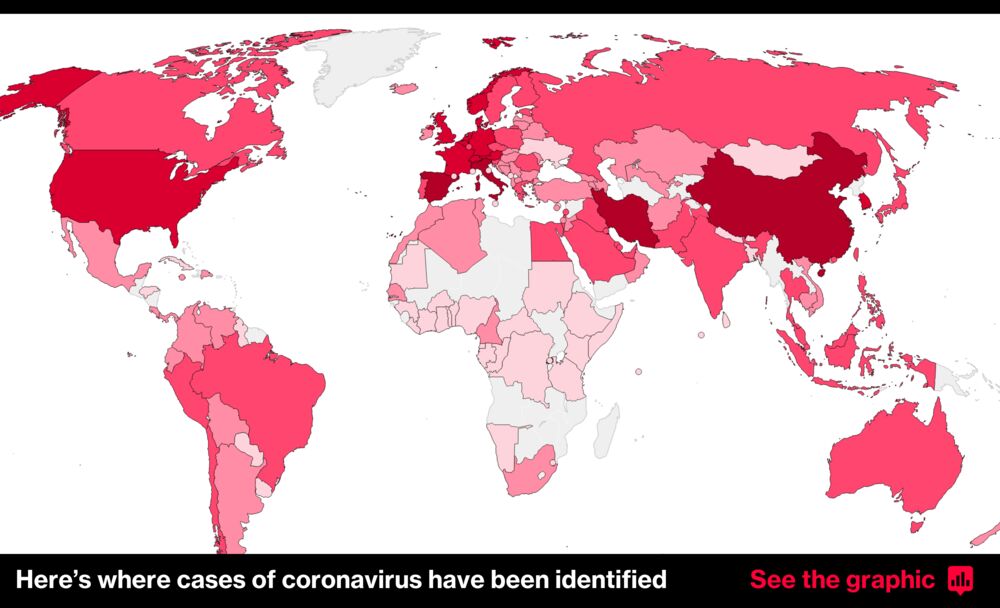
With China knowing it can not compete with the USA militarily it resorted to infect the whole world attacking 123 countries and torpedo their economies. This is a day-by-day, month-by-month breakdown of China’s coronavirus coverup and the irreparable damage it has caused around the globe.
The Timeline of a Viral Ticking Time Bomb

The story of the coronavirus pandemic is still being written. But at this early date, we can see all kinds of moments where different decisions could have lessened the severity of the outbreak we are currently enduring. You have probably heard variations of: “Chinese authorities denied that the virus could be transferred from human to human until it was too late.” What you have probably not heard is how emphatically, loudly, and repeatedly the Chinese government insisted human transmission was impossible, long after doctors in Wuhan had concluded human transmission was ongoing — and how the World Health Organization assented to that conclusion, despite the suspicions of other outside health experts.
Clearly, the U.S. government’s response to this threat was not nearly robust enough, and not enacted anywhere near quickly enough. Most European governments weren’t prepared either. Few governments around the world were or are prepared for the scale of the danger. We can only wonder whether accurate and timely information from China would have altered the way the U.S. government, the American people, and the world prepared for the oncoming danger of infection.
Some point in late 2019: The coronavirus jumps from some animal species to a human being. The best guess at this point is that it happened at a Chinese “wet market.”
December 6: According to a study in The Lancet, the symptom onset date of the first patient identified was “Dec 1, 2019 . . . 5 days after illness onset, his wife, a 53-year-old woman who had no known history of exposure to the market, also presented with pneumonia and was hospitalized in the isolation ward.” In other words, as early as the second week of December, Wuhan doctors were finding cases that indicated the virus was spreading from one human to another.
December 21: Wuhan doctors begin to notice a “cluster of pneumonia cases with an unknown cause.”
December 25: Chinese medical staff in two hospitals in Wuhan are suspected of contracting viral pneumonia and are quarantined. This is additional strong evidence of human-to-human transmission.
Sometime in “Late December”: Wuhan hospitals notice “an exponential increase” in the number of cases that cannot be linked back to the Huanan Seafood Wholesale Market, according to the New England Journal of Medicine.
December 30: Dr. Li Wenliang sent a message to a group of other doctors warning them about a possible outbreak of an illness that resembled severe acute respiratory syndrome (SARS), urging them to take protective measures against infection.
December 31: The Wuhan Municipal Health Commission declares, “The investigation so far has not found any obvious human-to-human transmission and no medical staff infection.” This is the opposite of the belief of the doctors working on patients in Wuhan, and two doctors were already suspected of contracting the virus.
Three weeks after doctors first started noticing the cases, China contacts the World Health Organization.
Tao Lina, a public-health expert and former official with Shanghai’s center for disease control and prevention, tells the South China Morning Post, “I think we are [now] quite capable of killing it in the beginning phase, given China’s disease control system, emergency handling capacity and clinical medicine support.”
January 1: The Wuhan Public Security Bureau issued summons to Dr. Li Wenliang, accusing him of “spreading rumors.” Two days later, at a police station, Dr. Li signed a statement acknowledging his “misdemeanor” and promising not to commit further “unlawful acts.” Seven other people are arrested on similar charges and their fate is unknown.
Also that day, “after several batches of genome sequence results had been returned to hospitals and submitted to health authorities, an employee of one genomics company received a phone call from an official at the Hubei Provincial Health Commission, ordering the company to stop testing samples from Wuhan related to the new disease and destroy all existing samples.”
According to a New York Times study of cellphone data from China, 175,000 people leave Wuhan that day. According to global travel data research firm OAG, 21 countries have direct flights to Wuhan. In the first quarter of 2019 for comparison, 13,267 air passengers traveled from Wuhan, China, to destinations in the United States, or about 4,422 per month. The U.S. government would not bar foreign nationals who had traveled to China from entering the country for another month.
January 2: One study of patients in Wuhan can only connect 27 of 41 infected patients to exposure to the Huanan seafood market — indicating human-to-human transmission away from the market. A report written later that month concludes, “evidence so far indicates human transmission for 2019-nCoV. We are concerned that 2019-nCoV could have acquired the ability for efficient human transmission.”
Also on this day, the Wuhan Institute of Virology completed mapped the genome of the virus. The Chinese government would not announce that breakthrough for another week.
January 3: The Chinese government continued efforts to suppress all information about the virus: “China’s National Health Commission, the nation’s top health authority, ordered institutions not to publish any information related to the unknown disease, and ordered labs to transfer any samples they had to designated testing institutions, or to destroy them.”
Roughly one month after the first cases in Wuhan, the United States government is notified. Robert Redfield, the director of the Centers for Disease Control and Prevention, gets initial reports about a new coronavirus from Chinese colleagues, according to Health and Human Services secretary Alex Azar. Azar, who helped manage the response at HHS to earlier SARS and anthrax outbreaks, told his chief of staff to make sure the National Security Council was informed.
Also on this day, the Wuhan Municipal Health Commission released another statement, repeating, “As of now, preliminary investigations have shown no clear evidence of human-to-human transmission and no medical staff infections.”
January 4: While Chinese authorities continued to insist that the virus could not spread from one person to another, doctors outside that country weren’t so convinced. The head of the University of Hong Kong’s Centre for Infection, Ho Pak-leung, warned that “the city should implement the strictest possible monitoring system for a mystery new viral pneumonia that has infected dozens of people on the mainland, as it is highly possible that the illness is spreading from human to human.”
January 5: The Wuhan Municipal Health Commission put out a statement with updated numbers of cases but repeated, “preliminary investigations have shown no clear evidence of human-to-human transmission and no medical staff infections.”
January 6: The New York Times publishes its first report about the virus, declaring that “59 people in the central city of Wuhan have been sickened by a pneumonia-like illness.” That first report included these comments:
Wang Linfa, an expert on emerging infectious diseases at the Duke-NUS Medical School in Singapore, said he was frustrated that scientists in China were not allowed to speak to him about the outbreak. Dr. Wang said, however, that he thought the virus was likely not spreading from humans to humans because health workers had not contracted the disease. “We should not go into panic mode,” he said.
Don’t get too mad at Wang Linfa; he was making that assessment based upon the inaccurate information Chinese government was telling the world.
Also that day, the CDC “issued a level 1 travel watch — the lowest of its three levels — for China’s outbreak. It said the cause and the transmission mode aren’t yet known, and it advised travelers to Wuhan to avoid living or dead animals, animal markets, and contact with sick people.”
Also that day, the CDC offered to send a team to China to assist with the investigation. The Chinese government declined, but a WHO team that included two Americans would visit February 16.
January 8: Chinese medical authorities claim to have identified the virus. Those authorities claim and Western media continue to repeat, “there is no evidence that the new virus is readily spread by humans, which would make it particularly dangerous, and it has not been tied to any deaths.”
The official statement from the World Health Organization declares, “Preliminary identification of a novel virus in a short period of time is a notable achievement and demonstrates China’s increased capacity to manage new outbreaks . . . WHO does not recommend any specific measures for travelers. WHO advises against the application of any travel or trade restrictions on China based on the information currently available.”
January 10: After unknowingly treating a patient with the Wuhan coronavirus, Dr. Li Wenliang started coughing and developed a fever. He was hospitalized on January 12. In the following days, Li’s condition deteriorated so badly that he was admitted to the intensive care unit and given oxygen support.
The New York Times quotes the Wuhan City Health Commission’s declaration that “there is no evidence the virus can spread among humans.” Chinese doctors continued to find transmission among family members, contradicting the official statements from the city health commission.
January 11: The Wuhan City Health Commission issues an update declaring, “All 739 close contacts, including 419 medical staff, have undergone medical observation and no related cases have been found . . . No new cases have been detected since January 3, 2020. At present, no medical staff infections have been found, and no clear evidence of human-to-human transmission has been found.” They issue a Q&A sheet later that day reemphasizing that “most of the unexplained viral pneumonia cases in Wuhan this time have a history of exposure to the South China seafood market. No clear evidence of human-to-human transmission has been found.”
Also on this day, political leaders in Hubei province, which includes Wuhan, began their regional meeting. The coronavirus was not mentioned over four days of meetings.
January 13: Authorities in Thailand detected the virus in a 61-year-old Chinese woman who was visiting from Wuhan, the first case outside of China. “Thailand’s Ministry of Public Health, said the woman had not visited the Wuhan seafood market, and had come down with a fever on Jan. 5. However, the doctor said, the woman had visited a different, smaller market in Wuhan, in which live and freshly slaughtered animals were also sold.”
January 14: Wuhan city health authorities release another statement declaring, “Among the close contacts, no related cases were found.” Wuhan doctors have known this was false since early December, from the first victim and his wife, who did not visit the market.
The World Health Organization echoes China’s assessment: “Preliminary investigations conducted by the Chinese authorities have found no clear evidence of human-to-human transmission of the novel coronavirus (2019-nCoV) identified in Wuhan, China.”
This is five or six weeks after the first evidence of human-to-human transmission in Wuhan.
January 15: Japan reported its first case of coronavirus. Japan’s Health Ministry said the patient had not visited any seafood markets in China, adding that “it is possible that the patient had close contact with an unknown patient with lung inflammation while in China.”
The Wuhan Municipal Health Commission begins to change its statements, now declaring, “Existing survey results show that clear human-to-human evidence has not been found, and the possibility of limited human-to-human transmission cannot be ruled out, but the risk of continued human-to-human transmission is low.” Recall Wuhan hospitals concluded human-to-human transmission was occurring three weeks earlier. A statement the next day backtracks on the possibility of human transmission, saying only, “Among the close contacts, no related cases were found.”
January 17: The CDC and the Department of Homeland Security’s Customs and Border Protection announce that travelers from Wuhan to the United States will undergo entry screening for symptoms associated with 2019-nCoV at three U.S. airports that receive most of the travelers from Wuhan, China: San Francisco, New York (JFK), and Los Angeles airports.
The Wuhan Municipal Health Commission’s daily update declares, “A total of 763 close contacts have been tracked, 665 medical observations have been lifted, and 98 people are still receiving medical observations. Among the close contacts, no related cases were found.”
January 18: HHS Secretary Azar has his first discussion about the virus with President Trump. Unnamed “senior administration officials” told the Washington Post that “the president interjected to ask about vaping and when flavored vaping products would be back on the market.”
Despite the fact that Wuhan doctors know the virus is contagious, city authorities allow 40,000 families to gather and share home-cooked food in a Lunar New Year banquet.
January 19: The Chinese National Health Commission declares the virus “still preventable and controllable.” The World Health Organization updates its statement, declaring, “Not enough is known to draw definitive conclusions about how it is transmitted, the clinical features of the disease, the extent to which it has spread, or its source, which remains unknown.”
January 20: The Wuhan Municipal Health Commission declares for the last time in its daily bulletin, “no related cases were found among the close contacts.”
That day, the head of China’s national health commission team investigating the outbreak, confirmed that two cases of infection in China’s Guangdong province had been caused by human-to-human transmission and medical staff had been infected.
Also on this date, the Wuhan Evening News newspaper, the largest newspaper in the city, mentions the virus on the front page for the first time since January 5.
January 21: The CDC announced the first U.S. case of a the coronavirus in a Snohomish County, Wash., resident who returning from China six days earlier.
By this point, millions of people have left Wuhan, carrying the virus all around China and into other countries.
January 22: WHO director-general Tedros Adhanom Ghebreyesus continued to praise China’s handling of the outbreak. “I was very impressed by the detail and depth of China’s presentation. I also appreciate the cooperation of China’s Minister of Health, who I have spoken with directly during the last few days and weeks. His leadership and the intervention of President Xi and Premier Li have been invaluable, and all the measures they have taken to respond to the outbreak.”
In the preceding days, a WHO delegation conducted a field visit to Wuhan. They concluded, “deployment of the new test kit nationally suggests that human-to-human transmission is taking place in Wuhan.” The delegation reports, “their counterparts agreed close attention should be paid to hand and respiratory hygiene, food safety and avoiding mass gatherings where possible.”
At a meeting of the WHO Emergency Committee, panel members express “divergent views on whether this event constitutes a “Public Health Emergency of International Concern’ or not. At that time, the advice was that the event did not constitute a PHEIC.”
President Trump, in an interview with CNBC at the World Economic Forum in Davos, Switzerland, declared, “We have it totally under control. It’s one person coming in from China. We have it under control. It’s going to be just fine.”
January 23: Chinese authorities announce their first steps for a quarantine of Wuhan. By this point, millions have already visited the city and left it during the Lunar New Year celebrations. Singapore and Vietnam report their first cases, and by now an unknown but significant number of Chinese citizens have traveled abroad as asymptomatic, oblivious carriers.
January 24: Vietnam reports person-to-person transmission, and Japan, South Korea, and the U.S report their second cases. The second case is in Chicago. Within two days, new cases are reported in Los Angeles, Orange County, and Arizona. The virus is in now in several locations in the United States, and the odds of preventing an outbreak are dwindling to zero.
On February 1, Dr. Li Wenliang tested positive for coronavirus. He died from it six days later.
One final note: On February 4, Mayor of Florence Dario Nardella urged residents to hug Chinese people to encourage them in the fight against the novel coronavirus. Meanwhile, a member of Associazione Unione Giovani Italo Cinesi, a Chinese society in Italy aimed at promoting friendship between people in the two countries, called for respect for novel coronavirus patients during a street demonstration. “I’m not a virus. I’m a human. Eradicate the prejudice.”
This kind of behaviour should not go on unpunished, China should bare the consequence by isolating it, and subjecting the CCP leaders like the Nuremberg trials in WWII.
This kind of behaviour should not go on unpunished, China should bare the consequence by isolating it, and subjecting the CCP leaders like the Nuremberg trials in WWII.

 India Drags China To International Court For COVID-19 War


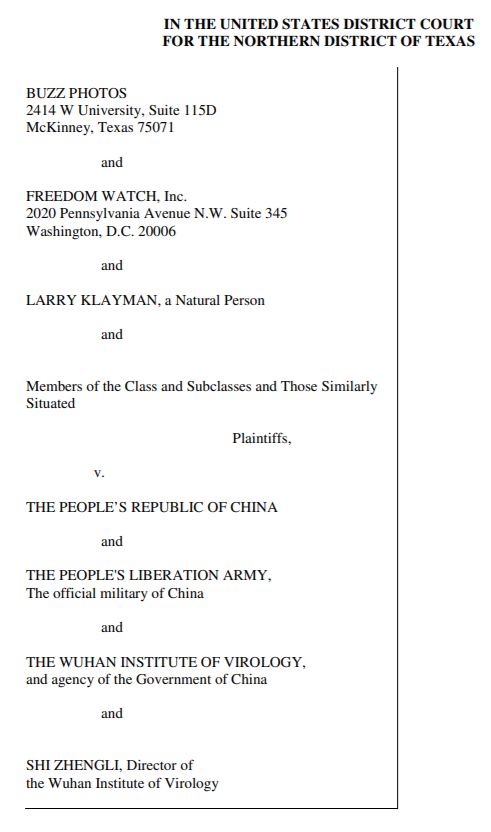 First page of the class action lawsuit brought by Larry Klayman against China for waging a Biological War.