Thursday, June 1, 2023


A  BOY’S MEMORIES OF MANILA


Manila Chinatown
Prior to the arrival of the Spaniards in 1571, trade between ethnic Filipino Malays and Chinese traders was already established in pre-colonial Manila. Manila's Chinatown is one of the oldest in Asia, established sometime in the late 17th century. It is home to many ethnic Chinese who left the Chinese mainland for a home in the Philippines. Binondo is a stone's throw away from the District of Intramuros, which was the Philippine's administrative capital under Spanish rule. The district was within the range of Intramuros' canons to quell any uprising the Chinese could have started. Binondo became a center of commerce during the American colonial era of the Philippines, since the Chinese were known to be experts in trading and finance. Banks, department stores, restaurants, insurance companies, nearly all giant commercial establishments were built in Binondo, the most prominent of which are located in the Escolta Avenue, though these are somewhat out of vogue and dilapidated today. World War II destroyed much of Binondo's commercial establishments. After the war, most companies relocated to Makati, the current central business district of Metro Manila.

Taal Volcano Left Photo


The Jones Bridge, initially named as the Puente Grande and later known as Puente de España, crosses the Pasig River and connects the districts of the Binondo, Chinatown and Escolta areas with the center of downtown Manila. This bridge is considered to be the oldest in all of the Philippines.


photo

calesa terminal. Kalesa (sometimes called a karitela) is a horse-driven carriage used in the Philippines. The word predates the Spanish conquest and descends ultimately from an Old Church Slavonic word meaning "wheels." This was one of the modes of transportation introduced in the Philippines in the 18th century.


Manila Yacht Club, Roxas Boulevard across the Blvd. was our old quarters at the Manila Naval Station (MNS)


My early recollection of the Legislative, Post office and the fortification near the Pasig River deserved some mention. Along these walls of Fort Santiago were a lot of Cogon grass that we use to clean and cut back in the mid 1950 as a civic duty and as a project for my cub scout den, designated then as Pack Number 1. During World War II, Fort Santiago was captured by the Japanese Imperial Army, and used its prisons and dungeons including the storage cells and gunpowder magazines for hundreds of prisoners who were killed near the end of the war.
MY SISTER ALETA, BELOW MY TITA CORING AND BABY CECILE


In the old days the walls were used as security and protection. Threats of invasion by Chinese, Japanese, Dutch and Portuguese pirates prompted the construction of defenses consisting of high stones walls, bulwarks and moats. The walls stretch to 4.5 kilometers in length, enclosing a pentagonal area aprrox. 64 hectares. The area consisted of residences, churches, palaces, schools and govt. buildings. Entry was made possible through gates w/ drawbridges, which were closed before midnite and opened at the break of dawn.


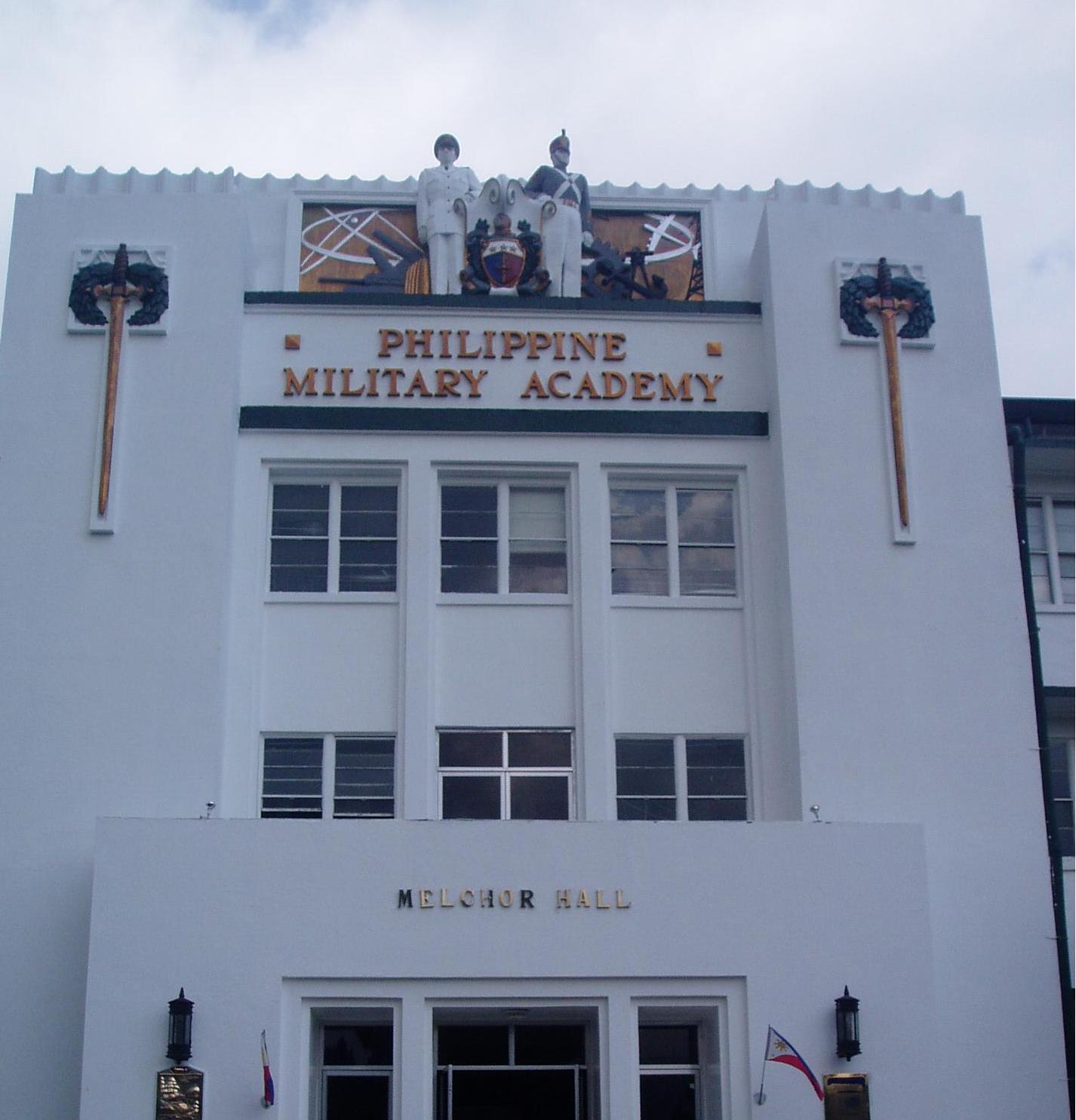
When the National Defense Act was approved on December 21, 1935, the Philippine Constabulary Academy was renamed Philippine Military Academy and was permitted to grant its graduates Bachelor of Science degrees after completion of their four-year curriculum.


My early socialization with non relatives of my age started within the elementary School from Grade 1 to 7. It was 1950, 5 years after the war, when I started schooling. The limited amount of classroom space was clearly evident then for the newly established Parochial School. It did not bother me about the location, maybe of my innocence about the specter of death, as we have our class inside the catacombs at the basement  of Espirito Santo Church. I can recall the names of my favorite girl classmates, just like yesterday. To me, they seem to be much nicer, more intelligent than what I feel about the boys. My early perceptions of the bullies in the class, that they were probably motivated by competition for attention, and reminder of who rules among the boys. Those who feel superior though, was never given any quarter, as I have that early sense of justice given to the underdog. So it follows in the years, how many scraps I have to go thru. This is the same all through High School. It is also a lesson to know about myself, as my motivation to study depends on who my teacher was. The more attractive she was the more studious I became.
What I remember about  Espiritu Santo Parochial School: it was  formally established in 1947 by Rev. Fr. William J. Duschak, SVD, former Vicar Apostolic of Calapan, Oriental Mindoro. Initially, classes were held in the parish hall. Due to the unprecedented increase in student enrolment, the high school department, the Annex 1 and the Annex II buildings were constructed in succession. The following years, Fr. Antonio Albrecht, SVD, the Holy Spirit Sisters and the Secular Clergy efficiently administered the operation of the school. In 1973, the Religious Missionaries of St. Dominic took over its management.
Our song…… E.S.P.S. all praise to thee Glad the song we raise to thee. Down the years we’ll love thy name. Thy renown we’ll all acclaim. Thy love and truth will ever be Stars to guide our loyalty A light to shine . . . . on life’s high sea Alma Mater ESPS. Sons and daughters sing to thee, Worthy gifts we bring to thee. Hearts we give thee loyal truth To those rare gifts we owe to you.


File:PMA gusali.JPG

Philippine Military Academy, Fort del Pilar, Baguio City.

PMA was modeled after the United States Military Academy with
 officers from the Philippine Scouts and regularUnited States Army as instructors and members of the general staff. With the outbreak of World War II, training was disrupted at the PMA with Classes 1942 and 1943 being graduated prematurely and assigned to combat units in Bataan and other parts of the country. Many of these young officers perished in the war. After the war, the Academy was reopened on May 5, 1947, at Camp Henry T. Allen in Baguio City. But due to its increasing need for larger grounds, it was soon moved to its present location at Fort Gen Gregorio H Del Pilar, Loakan, some ten kilometers from downtown Baguio. During the 1960s, as a need for more well-rounded individuals was found to be desirable, socio-humanistic courses were added to the school's curriculum.


Sangley Point My father became the CO of Sangley Point Cavite Naval Base in the 70’s.1960-photo


Ayuntamiento Building, Intramuros, Manila

Papa in the 60's as Commanding Officer(CO)  MNS, extreme left Cdr. Oscar L. Tempongko 


photo

File:Naval Station Sangley Point aerial2 c1964.jpg


1960: I became aware of my heritage in my junior year at UP Prep and began preparation for my appointment as a cadet of the PMA at Fort Del Pilar. This was a period in my teen years that I remember fondly, memories in my High School, of the hectic days, dashing thru the corridors catching my schedule of classes at Rizal Hall. I recall my bag loaded with books, eager, wide eyed, and quick to learn the tenets of math, the arts and sciences. I remember past friends and stormy situations that most teenagers weathered through. As in life surviving the unspoken pecking order among bigger classmates and the so called in crowd was the rule. That lone wolf streak that kept me apart, which peers seemed to see as a weakness was a measure of heritage that set me off from the current teenage precepts of the day. Later, being a late bloomer, when of age and after further studies, scholarships for a Masters in Civil Enginering at a California State U, having ever spurred curiosity, whetted my appetite for a life of adventure, of soldiering and foreign lands. 


My early socialization with non relatives of my age started within the elementary School from Grade 1 to 7. It was 1950, 5 years after the war, when I started schooling. The limited amount of classroom space was clearly evident then for the newly established Parochial School. It did not bother me about the location, maybe of my innocence about the specter of death, as we have our class inside the catacombs at the basement  of Espirito Santo Church. I can recall the names of my favorite girl classmates, just like yesterday. To me, they seem to be much nicer, more intelligent than what I feel about the boys. My early perceptions of the bullies in the class, that they were probably motivated by competition for attention, and reminder of who rules among the boys. Those who feel superior though, was never given any quarter, as I have that early sense of justice given to the underdog. So it follows in the years, how many scraps I have to go thru. This is the same all through High School. It is also a lesson to know about myself, as my motivation to study depends on who my teacher was. The more attractive she was the more studious I became.
What I remember about  Espiritu Santo Parochial School: it was  formally established in 1947 by Rev. Fr. William J. Duschak, SVD, former Vicar Apostolic of Calapan, Oriental Mindoro. Initially, classes were held in the parish hall. Due to the unprecedented increase in student enrolment, the high school department, the Annex 1 and the Annex II buildings were constructed in succession. The following years, Fr. Antonio Albrecht, SVD, the Holy Spirit Sisters and the Secular Clergy efficiently administered the operation of the school. In 1973, the Religious Missionaries of St. Dominic took over its management.
Our song…… E.S.P.S. all praise to thee Glad the song we raise to thee. Down the years we’ll love thy name. Thy renown we’ll all acclaim. Thy love and truth will ever be Stars to guide our loyalty A light to shine . . . . on life’s high sea Alma Mater ESPS. Sons and daughters sing to thee, Worthy gifts we bring to thee. Hearts we give thee loyal truth To those rare gifts we owe to you.


photo

Quezon Memorial Circle
Elliptical Road
Quezon City, Manila

photo

Dr. Jose Rizal Memorial

Paco Park and Cemetery
Paco, Manila

photo

Andres Bonifacio EDSA cor. Rizal Avenue
Caloocan, Manila


photo

Andres Bonifacio's monument in Caloocan City, Andrés Bonifacio was one of the chief leaders of the revolution of the Philippines against Spanish colonial rule. The 1896 Philippine Revolution was the first revolution in Asia against European colonial rule.

photo

Dugo sa Magdalena. Kinalugmukan ng duguang katawan ni Emilio Jacinto sa simbahan ng Magdalena, Laguna

photo

Mabini monument.This is Apolinario Mabini's monument located at the plaza fronting the city hall. Mabini, tagged as the "Sublime Paralytic", is a son of Tanauan.


In my days we just call this place as Luneta. Manila is the site of the country's premiere park, Rizal Park, which was erected for the country's national hero, José Rizal. Besides having parks and green areas, Manila is the home to several plazas, such as the Plaza Balagtas and Plaza Miranda, the site of the1971 politics-related bombings. Within Manila lies notable parks and green areas, such as the Cultural Center of the Philippines, the Rajah Sulayman Park, Manila Boardwalk, Liwasang Bonifacio, Mehan GardenPaco Park, Remedios Circle, the Manila Zoological and Botanical Garden, Pandacan Linear Park, and the Malacañang Garden.


National Press Club

Legaspi Urdaneta Monument  right photo


Intramuros – Manila This was the place where as a child, I  watched young men in fatigues with rifles. Later in college, I would be here, ROTC drills right there at the back of San Ignacio Church ....beside Ateneo ....on the Western side of Sta Lucia


photo

Phillipines Naval Special OperationsA member of the Naval Special Operations Group (NAVSOG) fires his automatic sub-machine gun during an anti-terrorism rescue operation at the Philippine Navy headquarters in Sangley Point, Cavite


Fort San Antonio Abad in Malate, Manila, Philippines,  from the south looking northwest. Fort Abad is of significant historical importance and a Philippine national treasure. It is strange that so few know about it. It is great that it survives today in good condition and is being protected. It has so much history behind it. The British invasion of Manila in 1762 took this fort first then the American invasion in 1898 did the same. It is located behind the Metropolitan Museum of Manila on Roxas Boulevard. This was the site of the old Manila Naval Station our old military quarters, across the Cultural Center of Imelda.


Sangley Point  Papa became CO of this base in the 1970.

Return of Sangley Point to the Republic of the Philippines 

File:Vought O2U Corsair over Cavite in 1930.jpg
  An O2U floatplane flies over the Cavite Navy Yard, circa 1930. The seaplane tender Jason is docked at the yard, directly below the plane. Sangley Point is in the background.


Going Home
 File:Cavite Navy Yard bombed aerial photo 10 Dec 1941.jpg


A Japanese air raid on 10 December 1941 leaves the Cavite Navy Yard in flames.


I remember my father on the bridge of RPS 1133, like the ship on the right. I was a pre school kid then, looking at a young Lt. taking his ship out to the open seas, out of Manila Bay. 1960: I became aware of my heritage in my junior year at UP Prep and began preparation for my appointment as a cadet  at the PMA at Fort Del Pilar. This was a period in my teen years that I remember fondly, memories in my High School, of the hectic days, dashing thru the corridors catching my schedule of classes at Rizal Hall. I recall my bag loaded with books, eager, wide eyed, and quick to learn the tenets of math, the arts and sciences.
I remember past friends and stormy situations that most teenagers weathered through. As in life surviving the unspoken pecking order among bigger classmates and the so called in crowd was the rule. That lone wolf streak that kept me apart, which peers seemed to see as a weakness was a measure of heritage that set me off from the current teenage precepts of the day. Classmates underestimated me a poor kid, just a son of a sailor, short in stature and have not reached  the growth expected of my age. My inner strength was formed this way. My full attention was now focused to strive, improve myself and  the planned transfer of the whole family to the USA by advanced education.  Later in full bloom, when of age and after further studies and scholarships, having ever spurred curiosity, whetted my appetite for a life of adventure, of soldiering and foreign lands.


Dewey Blvd: The jetty potruding out to Manila Bay is the future Cultural Center, on the other side of Dewey is the Manila Naval Station (MNS) where we lived from 1965 to 1966. the headquarters of the Philippine Navy was relegated to a small block of land south of the Manila Yacht Club. The original plan was to reclaim the site of the cultural center(CC) to replace the location of the MNS by the Central Bank together with the Gold Reserve of the Philippines. The Marcoses, made this sinister evil plan to transport easily 400 tons of gold to navy ships across the street, also saw this valuable real state and confiscated the plan for her project the now this monstrousity Cultural Center. The yacht club remained, the Navy base (MNS) was transferred to Fort Bonifacio.


Fort San Antonio Abad Malate; Manila

I remember this building pretty well. When I was a child, my mother and I would collect the salary from the cashier’s office, while my father was away on missions. Then later on, lived across Roxas Blvd. when father was the CO of the Manila Naval Station. Above is the Philippine Navy headquarter building in Metro Manila. This was also the venue of my High School graduation ball at the officer’s club in 1961.


The old  Navy base inside Manila Naval Station at Dewey Blvd. adjacent to the Manila Yacht Club. The Manila Cultural Center foreground/below


Papa and his various duty assignments in the 60's who left our midst Feb. 2010. Early in his career as a naval officer, seldom we see him for a decade as he was out to the Southern seas in Mindanao fighting the banditry and secession movements of the muslims. He will go on to higher positions, to take command of his own ship, then a number of ships as a task force commander, then Chief of Staff of the Philippine Coast Guard, a professor in academia at the National Defense College of the Philippines, Dean at the Command and General Staff College, a base commander at the Manila Naval Station and Cavite Naval Base at Sangley Pt. But what I remember most was him on the bridge of RPS 1133, and I a pre school kid, looking at a young Lt. taking his ship out to the open seas, 
out of Manila Bay.

photo


Ramparts of Fort San Antonio Abad where the old HQ of MNS was an addendum perched on top. The old building is gone but the fort remains in its original grandeur.


MANILA  NAVAL  STATION now Jose V. Andrada Naval Station Manila, Philippines.


Manila Bay is a natural harbour which serves the Port of Manila (on Luzon), in the Philippines. The bay is considered to be one of the best natural harbours in Southeast Asia and one of the finest in the world. Strategically located around the capital city of the Philippines, Manila Bay simplified commerce and trade between the Philippines and its neighbouring countries, becoming the gateway for socio - economic development even before Spanish occupation. With an area of 1,994 km 2 (769.9 sq mi), and a coastline of 190 km ( 118.1 mi ), Manila Bay is situated in the western part of Luzon and is bounded by Cavite and Metro Manila on the east, Bulacan and Pampanga on the north, and Bataan on the west and northwest. Manila Bay drains about 17,000 km 2 ( 6,563.7 sq mi ) of watershed area, with the Pampanga River contributing about 49% of the freshwater influx. With an average depth of 17 m ( 55.8 ft ), it is estimated to have a total volume of 28.9 billion cubic meters ( 28.9 cubic km ). Entrance to the bay is 19 km ( 11.8 mi ) wide and expands to a width of 48 km (29.8 mi). However, width of the bay varies from 22 km ( 13.7 mi ) at its mouth and expanding to 60 km (37.3 mi) at its widest point.
The islands of Corregidor and Caballo divides the entrance into two channels, about two miles ( 3.2 km ) towards the North and 6.5 miles (10.5 km) wide on the South side. Mariveles, in the province of Bataan, is an anchorage just inside the northern entrance and Sangley Point is the former location of Cavite Naval Base. On either side of the bay are volcanic peaks topped with tropical foliage: 40 km to the north is the Bataan Peninsula and to the south is the province of Cavite.


Anchor at Fort San Antonio Abad

Wall of Fort San Antonio Abad


photo

Defense Secretary Ramon Magsaysay overseeing the capture of William Pomeroy, an American ideologist and leader of the 

Nueva Ecija Huk Propaganda Corps. Prior to assuming the presidency, RM was Defense Secretary in Pres. Elpidio Quirino’s Cabinet. 

For more information on the capture of William Pomeroy

Atty. Diosdado Macapagal raises the Philippine flag at Turtle Islands.<br />The caption reads:<br /><br />Atty. Macapagal got his first break as a public figure in 1948 when Vice President Quirino, then concurrently Secretary of Foreign Affairs, appointed him as Assistant Chief of its Law Division and assigned him to negotiate the return of the administration of the Turtle Islands from the United Kingdom to the Philippines. He succeeded and [Vice President] Quirino gave him the privilege of raising the Philippine flag over the islands. <br />- From Nipa Hut to Presidential Palace by Diosdado Macapagal<br />L
 

Atty. Diosdado Macapagal raises the Philippine flag at Turtle Islands

Atty. Macapagal got his first break as a public figure in 1948 when 
Vice President Quirino, then concurrently Secretary of Foreign 
Affairs, appointed him as Assistant Chief of its Law Division and
 assigned him to negotiate the return of the administration of the 
Turtle Islands from the United Kingdom to the Philippines. 
He succeeded and [Vice President] Quirino gave him the privilege
 of raising the Philippine flag over the islands.


Review at Fort William McKinley Manila Philippines

Ruins at Corregidor

Ferry Dock

Across the entrance to Manila Bay are several islands, the largest of which is Corregidor, located three kilometres from Bataan and, along with the island of Caballo, separates the mouth of the bay into the North and South Channels. In the south channel is El Fraile Island and outside the entrance, and to the south, is Carabao Island. El Fraile, a rocky island some four acres ( 1.6 ha ) in area, supports the massive concrete and steel ruins of Fort Drum, an island fortress constructed by the United States Army to defend the southern entrance of the bay. To the immediate north and south are additional harbors, on which both local and international ports are situated. Large number of ships at the North and South harbors facilitate maritime activities in the bay. Being smaller of the two harbors, the North Harbor is used for inter-island shipping while the South Harbor is used for large ocean-going vessels.
Manila Bay was connected to Laguna Lake ( or Laguna de Bai) about 3,000 years ago. Recurring episodic uplifts along the West Marikina Valley Fault caused the two to break up. Interaction between Manila Bay and Laguna Lake occurs only through Pasig River.
The bay was the setting for the Battle of Manila Bay in 1898 in which American troops led by Commodore George Dewey, seized the area. Significantly, this battle showcased the United States' naval strength when all major Spanish ships were destroyed and captured. With its proud historic past and the place brimming with marine life, Manila Bay became the ocean portal to its epicentre for government, economy and industry. Seven years later during the Russo-Japanese War at the close of the Battle of Tsushima in 1905, three surviving Russian protected cruisers, the Aurora, Zhemchug, and Oleg, managed to make port in then-United States-controlled Manila for repairs. But because the US was a neutral power, the trio of warships and their crews remained interned by the U.S. until the war officially ended in September that year. In World War II, Corregidor Island was annexed by Japanese forces fighting from this bay once again in 1942. Even earlier various other battles were fought from this naval base including the La Naval de Manila in 1646, which finally put a stop gate to the Dutch trials to seize the Philippines


Independent Philippines and the Third Republic (1946-1972). In April 1946, elections were held. Despite the fact that the Democratic Alliance won the election, they were not allowed to take their seats under the pretext that force had been used to manipulate the elections. The United States withdrew its sovereignty over the Philippines on July 4, 1946, as scheduled.


Manuel Roxas (Liberal Party), having been inaugurated as President as scheduled, on July 4, 1946 before the granting of independence, strengthened political and economic ties with the United States in the controversial Philippine-US Trade Act, In Mar., 1947, the Philippines and the United States signed a military assistance pact (since renewed) which allowed the US to participate equally in the exploitation of the country's natural resources—and rented sites for 23 military bases to the US for 99 years (a later agreement reduced the period to 25 years beginning 1967). These bases would later be used to launch operations in the areas of Korea, China, Vietnam, and Indonesia.
During the Roxas administration, a general amnesty was granted for those who had worked together with the Japanese while at the same time the Huks were declared illegal. His administration ended prematurely when he died of heart attack April 15, 1948 while at the US Air Force Base in Pampanga.
Vice President Elpidio Quirino (Liberal Party, henceforth referred to as LP) was sworn in as President after the death of Roxas in April 1948. He ran for election in November 1949 against Jose P. Laurel (Nacionalista Party, henceforth referred to as NP) and won his own four-year term.
During this time, the CIA under the leadership of Lt. Col. Edward G. Lansdale was engaged in paramilitary and psychological warfare operations with the goal to hold back the Huk Movement. Among the measures which were undertaken were psyops-campaigns which demoralized the superstition of many Filipinos and acts of violence by government soldiers which were disguised as Huks. By 1950, the U.S. had provided the Philippine military with supplies and equipment worth $200 million dollars.
The huge task of reconstructing the war-torn country was complicated by the activities in central Luzon of the Communist-dominated Hukbalahap guerrillas (Huks), who resorted to terror and violence in their efforts to attain land reform and gain political power. They were finally brought under control (1954) after a dynamic attack introduced by the minister of national defense, Ramón Magsaysay. By that time Magsaysay was president of the country, having defeated Quirino in Nov., 1953. His campaign was massively supported by the CIA, both financially and through practical help in discrediting his political enemies. He had promised sweeping economic changes, and he did make progress in land reform, opening new settlements outside crowded Luzon Island. His death in an airplane crash in Mar., 1957, was a serious blow to national morale. Vice President Carlos P. García succeeded him and won a full term as president in the elections of Nov., 1957.
In foreign affairs, the Philippines preserved a firm anti-Communist policy and joined the Southeast Asia Treaty Organization in 1954. There were difficulties with the United States over American military installations in the islands, and, in spite of formal recognition (1956) of full Philippine sovereignty over these bases, tensions increased until some of the bases were dismantled (1959) and the 99-year lease period was reduced. The United States rejected Philippine financial claims and projected trade revisions.

Sangley Point


NAVAL STATION SANGLEY POINT, Republic of the Philippines  Lcpl. Kenneth Pollard assigned to Fleet Anti-Terrorism Security Team Pacific (FAST), teaches sailors and marines martial arts techniques during a professional development exchange with the Armed Forces of the Philippines. FAST is embarked on board the U.S. 7th Fleet command ship USS Blue Ridge (LCC 19), which is in Manila, Republic of the Philippines for a port visit, and on it's spring patrol of the Asia-Pacific.(US Navy photo by Mass Communications Specialist 1st Class Greg Mitchell/Released)


Plaza Moraga-Estrella del Norte entrance-m1950s
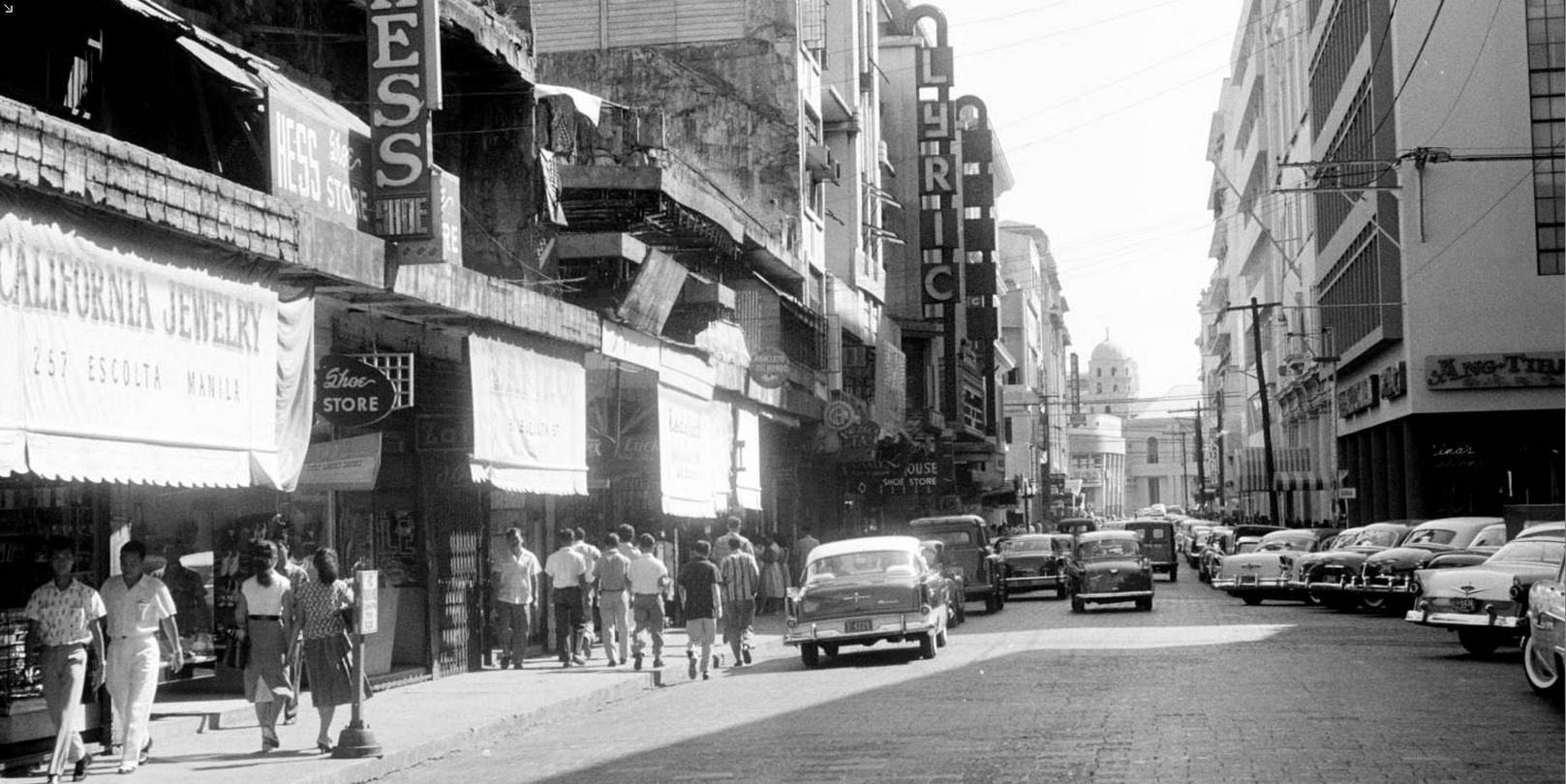
Estrella DEL NORTE, ESCOLTA 1955

Philippine opposition to García on issues of government corruption and anti-Americanism led, in June, 1959, to the union of the Liberal and Progressive parties, led by Vice President Diosdado Macapagal, the Liberal party leader, who succeeded García as president in the 1961 elections. Macapagal’s administration was marked by efforts to combat the mounting rise that had plagued the republic since its birth; by attempted alliances with neighboring countries; and by a territorial argument with Britain over North Borneo (later Sabah), which Macapagal claimed had been leased and not sold to the British North Borneo Company in 1878.

 
Inside the walls of Intramuros, The location of MIT.  One of the seven Gates. The construction of Intramuros started in 1571 by Miguel Lopez de Legaspi, a Spaniard. The walled city covers an area of about 160 acres. Intramuros was a fortress city with walls 6 metres high and a commanding 3 kilometres in length, it is no wonder it was impenetrable. Only the Spanish elite and Mestizos (mixed race) were permitted to live inside Intramuros, where at night the city gates were locked down.


Return of Sangley Point to the Republic of the Philippines 

File:Vought O2U Corsair over Cavite in 1930.jpg
  

An O2U floatplane flies over the Cavite Navy Yard, circa 1930. The seaplane tender Jason is docked at the yard, directly below the plane. Sangley Point is in the background.
 

Across the entrance to Manila Bay are several islands, the largest of which is Corregidor, located three kilometres from Bataan and, along with the island of Caballo, separates the mouth of the bay into the North and South Channels. In the south channel is El Fraile Island and outside the entrance, and to the south, is Carabao Island. El Fraile, a rocky island some four acres ( 1.6 ha ) in area, supports the massive concrete and steel ruins of Fort Drum, an island fortress constructed by the United States Army to defend the southern entrance of the bay. To the immediate north and south are additional harbors, on which both local and international ports are situated. Large number of ships at the North and South harbors facilitate maritime activities in the bay. Being smaller of the two harbors, the North Harbor is used for inter-island shipping while the South Harbor is used for large ocean-going vessels.
Manila Bay was connected to Laguna Lake ( or Laguna de Bai) about 3,000 years ago. Recurring episodic uplifts along the West Marikina Valley Fault caused the two to break up. Interaction between Manila Bay and Laguna Lake occurs only through Pasig River.
The bay was the setting for the Battle of Manila Bay in 1898 in which American troops led by Commodore George Dewey, seized the area. Significantly, this battle showcased the United States' naval strength when all major Spanish ships were destroyed and captured. With its proud historic past and the place brimming with marine life, Manila Bay became the ocean portal to its epicentre for government, economy and industry. Seven years later during the Russo-Japanese War at the close of the Battle of Tsushima in 1905, three surviving Russian protected cruisers, the Aurora, Zhemchug, and Oleg, managed to make port in then-United States-controlled Manila for repairs. But because the US was a neutral power, the trio of warships and their crews remained interned by the U.S. until the war officially ended in September that year. In World War II, Corregidor Island was annexed by Japanese forces fighting from this bay once again in 1942. Even earlier various other battles were fought from this naval base including the La Naval de Manila in 1646, which finally put a stop gate to the Dutch trials to seize the Philippines


photo


photo

Fort San Antonio Abad • Manila

Looking across Manila Bay on top of the wall of 

Fort San Antonio  Abad in Malate, Philippines.

This picture shows how close Manila Bay was to 

the Fort prior to the Cultural Center. 

Right breakwater MNS

 I missed this early morning and late afternoon call to the


I remember this building pretty well. When I was a child, my mother and I would collect the salary from the cashier’s office, while my father was away on missions. Then later on, lived across Roxas Blvd. when father was the CO of the Manila Naval Station. Above is the Philippine Navy headquarter building in Metro Manila. This was also the venue of my High School graduation ball at the officer’s club in 1961.


LATE 1960: DESTINATION SAN FRANCISCO USA


I would be remiss if I do not mention my favorite swimming hole in Tanay, Daranak Falls. Remembering fondly, cherishing memories of early summer vacations spent at this place. This 14-meter high falls is truly a refreshing site. A short walk over the top of Daranak are smaller, cascading streams known as Batlag Falls. It is located at Bgy. Tandang Kutyo in the town of Tanay. The place has been transformed into a public park/resort operated by the government.

photo

Aurora Blvd.-Cubao1950's-1970's Metro Manila,


Old Capitol Movie Theater

Capitol Theatre Art Deco in Escolta, Manila. Capitol used to be one of the finest movie houses in the Philippines until the 1960s.


A smile shines thru. The Philippine Santa Cruzan celebration is held each month of May. It highlights a religious procession participated in by beautiful ladies, among them a "Reyna Elena." They depict the historic search of the Holy Cross by Queen Helena and her son Constantine the Great. Typical corner cafe and street vendor up front

photo

Manila hemp arriving in cart loads at a Manila warehouse


Carabao cart hauling lumber the old energy efficient Filipino way, Manila

photo

Ayuntamiento Building, Intramuros, Manila


Beyond Human's wildest hopes, the Philippines is home to a wealth of archeological discoveries that have revolutionized our knowledge of human history. Right from the finding of mutilated rhinoceros bones in the Philippines, which casts doubt on the current knowledge of the 709,000-year-old human migration across Asia, to the amazing finding of the homo Luzonensis fossils in the Philippines, which serve as evidence of the worldwide archaeologists' cooperative efforts. There are lots of terrifying findings about the Philippines that have changed its status quo. What brought about the discovery of the Angono petroglyphs? Let’s find out. Scientists have exquisitely traced the evolution of the Philippines into existence to about 709,000 years ago, with the earliest known human activity in the archipelago. At this intriguing period, the Island of Luzon was once home to the extinct human species Homo Luzonensis, at least 67,000 years ago. The first anatomically modern Human was found at the Tabon Caves in Palawan approximately 47,000 years ago. Amazingly, research revealed that the Negrito clans were the first people to settle in the ancient Philippines. Following them were Asiatics, Papuans, and South Asians. Maritime Austronesians, who migrated southward from Taiwan in 3000 BC, make up most of the current population. By 2000 B.C., the archipelago served as the hub of a Trans-Oceanic Philippine jade culture. discovery,unexplained,mysterious,top 10,top 15,space,universe,science,techology,mystery,facts,interesting,discovery channel,discovery plus,scientists discovery,aliens,ufo,terrifying discoveries,top,they discovered,invention,future,galaxy,james webb,elon musk,business,entertainment,Uncovered Files,betelgeuse,space news,universe news,largest underwater volcano has suddenly cracked open the earth,yellowstone volcano,terrifying discovery,volcano,


We stumbled at this little town of lipa Laguna not knowing the significance of this place in the history of the Philippines. Brace yourselves for a jaw-dropping revelation that will shatter everything you thought you knew about the Philippines. This is not your typical travel brochure tale; it's a mind-blowing journey into a realm of scientific discovery that will leave you questioning the very fabric of history. Are you ready to uncover the secrets hidden in the heart of Southeast Asia? Buckle up because what we're about to reveal will send shockwaves through your understanding of this tropical paradise. Nestled amidst over 7,600 islands, the Philippines has long been celebrated for its diverse beauty and captivating charm. From world-renowned beaches to lush mountain landscapes, it's a tropical haven like no other. But beneath its surface lies a secret that has the scientific community buzzing with excitement. Forget the stereotypes; this isn't just about karaoke and street basketball. Beyond its economic rise and territorial disputes, the Philippines conceals a treasure trove of archaeological wonders that rewrite the narrative of human history.


Frequently, it is stated that the Philippine's history is commonly associated with foreign colonization. There are limited historical records that document the diverse culture of the indigenous Filipinos before the arrival of the Spanish. Nevertheless, archaeological findings, such as the evidence of rhino butchering and the discovery of Homo Luzonensis, provide compelling proof that ancient humans had already inhabited the country thousands of years ago.

photo

CABALLO ISLAND AT THE MOUTH OF MANILA BAY

Caballo Island (which means "Horse Island" in Spanish) is a bluff, rocky island located at the entrance to Manila Bay in the Philippines. It is about 1.2 km (0.75 mi) long with the highest elevation at 381 feet high. Caballo, along with the larger Corregidor (2 km to the north), divides the entrance to the bay into two broad and deep channels, known as the North and South Channel.


photo

Defense Secretary Ramon Magsaysay overseeing the capture of William Pomeroy, an American ideologist and leader of the 

Nueva Ecija Huk Propaganda Corps. Prior to assuming the presidency, RM was Defense Secretary in Pres. Elpidio Quirino’s Cabinet. 

For more information on the capture of William Pomeroy

Atty. Diosdado Macapagal raises the Philippine flag at Turtle Islands.<br />The caption reads:<br /><br />Atty. Macapagal got his first break as a public figure in 1948 when Vice President Quirino, then concurrently Secretary of Foreign Affairs, appointed him as Assistant Chief of its Law Division and assigned him to negotiate the return of the administration of the Turtle Islands from the United Kingdom to the Philippines. He succeeded and [Vice President] Quirino gave him the privilege of raising the Philippine flag over the islands. <br />- From Nipa Hut to Presidential Palace by Diosdado Macapagal<br />
 

Atty. Diosdado Macapagal raises the Philippine flag at Turtle Islands

Atty. Macapagal got his first break as a public figure in 1948 when 
Vice President Quirino, then concurrently Secretary of Foreign 
Affairs, appointed him as Assistant Chief of its Law Division and
 assigned him to negotiate the return of the administration of the 
Turtle Islands from the United Kingdom to the Philippines. 
He succeeded and [Vice President] Quirino gave him the privilege
 of raising the Philippine flag over the islands.


Review at Fort William McKinley Manila Philippines

Ruins at Corregidor

Ferry Dock


I remember this building pretty well. When I was a child, my mother and I would collect the salary from the cashier’s office, while my father was away on missions. Then later on, lived across Roxas Blvd. when father was the CO of the Manila Naval Station. Above is the Philippine Navy headquarter building in Metro Manila. This was also the venue of my High School graduation ball at the officer’s club in 1961.

Hospital Jabidah Grafitti. There is another story of Corregidor that is much less well known. Back in 1968, there was a slaughter of muslim Filipino soldiers training on the island by then Philippine President Ferdinand Marcos which became known as the Jabidah Massacre. To make a long story short for my American friends think of it in these terms: It's as If President Kennedy during the Bay of Pigs had killed all the Cubans he trained to invade Cuba because they changed their minds and refused to go through with it. Having a large force of disgruntled, well trained and armed revolutionaries on Corregidor, Marcos decided to have them liquidated. On 18 March 1968, all these specially trained soldiers meant to invade the Malaysian island of Sabah were murdered at Kindley Airfield. As the story is told from the Corregidor guide, these soldiers that were killed apparently wrote their names on the walls of the hospital in the days preceding their deaths.


I missed this early morning and late afternoon call to the
colors at (MNS), this bugle call melody is used to accompany the raising of the Flag (the national colors). It's used when no band is available to render honors. "When it's played on military bases, all uniformed personnel are required to come to attention and present a salute, either to the flag, or in the direction of the music if the flag is notvisible"


I missed this early morning and late afternoon call to the
colors at (MNS), this bugle call melody is used to accompany the raising of the Flag (the national colors). It's used when no band is available to render honors. "When it's played on military bases, all uniformed personnel are required to come to attention and present a salute, either to the flag, or in the direction of the music if the flag is not visible"
When World War II began, the Philippines had no significant naval forces after the United States withdrew the Asiatic Fleet following the Attack on Pearl Harbor by the Imperial Japanese Navy. The The Philippines had to rely on its OSP with headquarters located at Muelle Del Codo, Port Area, Manila which composed of a high-speed Thorneycroft Coast Motor Boat (CMB) 55-foot (17 m) and 65-foot (20 m) PT boats, to repel Japanese attacks from the sea.During the course of the war, surviving personnel of the Offshore Patrol conducted guerilla hit-and-run attacks against the occupying Japanese forces.


Corregidor on the horizon. Between December 24, 1941 and February 19, 1942, Corregidor became the temporary location for the Government of the Philippines. On December 30, 1941, outside the Malinta Tunnel, Manuel L. Quezon and Sergio Osmeña were inaugurated respectively as President and Vice-President of the Philippines Commonwealth for a second term.


The Tail of Corregidor Island with Hooker's Point at the farthest end


Church at the Campo Santo de La Loma. Today it is All Saints' Day. Filipinos observe this day by visiting their dead relatives in cemeteries and memorial parks and columbariums, go to church and light candles in commemoration of this day


deci


In late December 1941, following the failure of MacArthur's gamble to hold the Japanese invaders at the beaches, the fate of the Philippines seemed sealed. As the Japanese successfully stormed the shores of Lingayen Gulf and Lamon Bay, splitting Luzon, the largest island in the Philippines, in half, MacArthur had no other alternative but to order his troops to withdraw to the Bataan peninsula, where he planned to make a last stand and at the same time he ded to abandon all efforts to defend Manila declared it an open city, to save the capital from destruction and to minimise civilian casualties.


Father in the mountains of Vancover Canada with Lt. Munoz and Lcdr. Cabal, I also remember him on the bridge of RPS 1133, like the ship on the right. I was a pre school kid then, looking at a young Lt. taking his ship out to the open seas, out of Manila Bay. 1960: I became aware of my heritage in my junior year at UP Prep and began preparation for my appointment as a cadet  at the PMA at Fort Del Pilar. This was a period in my teen years that I remember fondly, memories in my High School, of the hectic days, dashing thru the corridors catching my schedule of classes at Rizal Hall. I recall my bag loaded with books, eager, wide eyed, and quick to learn the tenets of math, the arts and sciences.
I remember past friends and stormy situations that most teenagers weathered through. As in life surviving the unspoken pecking order among bigger classmates and the so called in crowd was the rule. That lone wolf streak that kept me apart, which peers seemed to see as a weakness was a measure of heritage that set me off from the current teenage precepts of the day. Classmates underestimated me a poor kid, just a son of a sailor, short in stature and have not reached  the growth expected of my age. My inner strength was formed this way. My full attention was now focused to strive, improve myself and  the planned transfer of the whole family to the USA by advanced education.  Later in full bloom, when of age and after further studies and scholarships, having ever spurred curiosity, whetted my appetite for a life of adventure, of soldiering and foreign lands.

La Loma Cemetery, memorable for its vegetation and semi rural setting that attracts the youth for adventure specially at twilight and even at pitch dark on a moonless night. Every year in the last week of October, Filipinos take a Roman Catholic inspired holiday to remember the dead. Cemeteries all over the country come alive during these days, as relatives of the dead spruce up the graves of their ancestors.


Japanese Sentry Tower - Camp O'Donnell, Capas, Tarlac


Camp O'Donnel (Capas Tarlac). the American sector of the war memorial.
photo

Bataan Death March Box Car

In San Fernando the POW’s where loaded on the trains bound for CapasTarlac, The Boxcars normally carried 50 persons, but the Japanese packed them up 100 to 115 Prisoners. At each stop, The Boxcars were open to give the Prisoners fresh Air. The POW’s got off the train at Capas and marched the final kilometer to Camp O” Donnell.
photo

Libingan ng mga bayani. Fort Bonifacio.

photo

Camp O'Donnel (Capas, Tarlac)

Camp O'Donnel (Capas, Tarlac)Established in 1940 as a USAFFE training camp, Camp O’Donnel became known as the Capas Concentration Camp where some 60,500 survivors of the Bataan Death March were incarcerated. Around 30,000 of these prisoners-of-war were dead by 1942. Camp O'Donnell was the final stop of the Bataan Death March and was used as an internment camp for Filipino and American prisoners of war. Around 20,000 Filipinos and 1,600 Americans died at Camp O'Donnell.[1] Filipino and American soldiers were said to have been beheaded in front of open graves. It was liberated by the US Army and Philippine Commonwealth Army on 30 January 1945.The remains of the dead were started to be moved to the Libingan ng mga Bayani and United States Military Cemetery in Fort Bonifacio in 1946.


Reconstructed hut and guard tower


Reconstructed hut and guard tower


Although La Loma  was not a haunted Cemetery,  to my belief, there was a time I got stranded after an afternoon play with a classmate. It became a different setting when darkness fell, I felt so alone and just walked fast to get away from the surrounding concrete fence of La Loma.
I have been there in 1953 to 1957 and many stories of the ghost of recent burials and internments were circulating around. The image of a young Japanese artillery officer with a close beard  haunted the outside graves. Walking  in short pants with his samurai sword slung at his side wearing his soldier’s tunic, or seen sitting alone smoking. The description is aptly backed, by the presence of canons, field pieces in the cemetery. He just walks up to visitors and usually asks for a light. Many startled mourners say he will attend a funeral and walk up at the end of services tap you on the shoulder ask for a light. Simply it has been said that, you turn and he's not there.

Camp O'Donnel (Capas Tarlac). the American sector of the war memorial.
The Cement Cross
In wishing to honor our comrades who died so far away from home the battling bastards of Bataan Death March commissioned the construction of this Replica of the “Cement Cross” in the hope that all those who may pass by to view this memorial will remember the many young Americans who gave their lives in defense of their country and of the Philippines.
In June of 1942 the Japanese authorities at the American side of the Prisoner of war enclosure at Camp O” Donnell, two kilometers north of this site presented the prisoners with some Cement. The American Prisoners decided to build a Cement Cross to honor the memory of their dead comrades. Completed later that month. The cross remained hidden amidst tall grass until was discovered by returning American Forces in 1945. Left where it originally stood unknown to most and battered by the elements. The cross was again forgotten. Rediscovered by Bataan Veterans visiting the area in 1961. The cross became the historical symbol of the American Prisoner of war enclosure and its dead. When American military presence ended in the Philippines in 1992. The cross was brought to the National Historic Site Andersonville, Georgia, USA. Where it is now kept and displayed. This Replica stand as a reminder of America’s unprepared ness before the outbreak of World War II.


Libingan ng mga BAYANI

Coast Guard At Port Area Manila left photo, La loma Cemetery next above, Libingan ng mga Bayani (heroes cemetery) Fort Bonifacio close to where we live at the Navy Village, Fort William McKinley then (Fort Bonifacio)  
It was the final stage of the tragic death march and a concentration camp with an open field which served as the dumping grave site of Filipino and American soldiers who died with debilitating diseases. It has witnessed the endless sufferings of the sick and the neglected only to die, then dropped in mass with three and half feet depth and those who survived the darkest moments of their lives, they narrated with tears clouding their eyes, the traumatic experiences encountered during their detention, as they gasped with depression and sadness and said CAMP O” Donnell, that was.


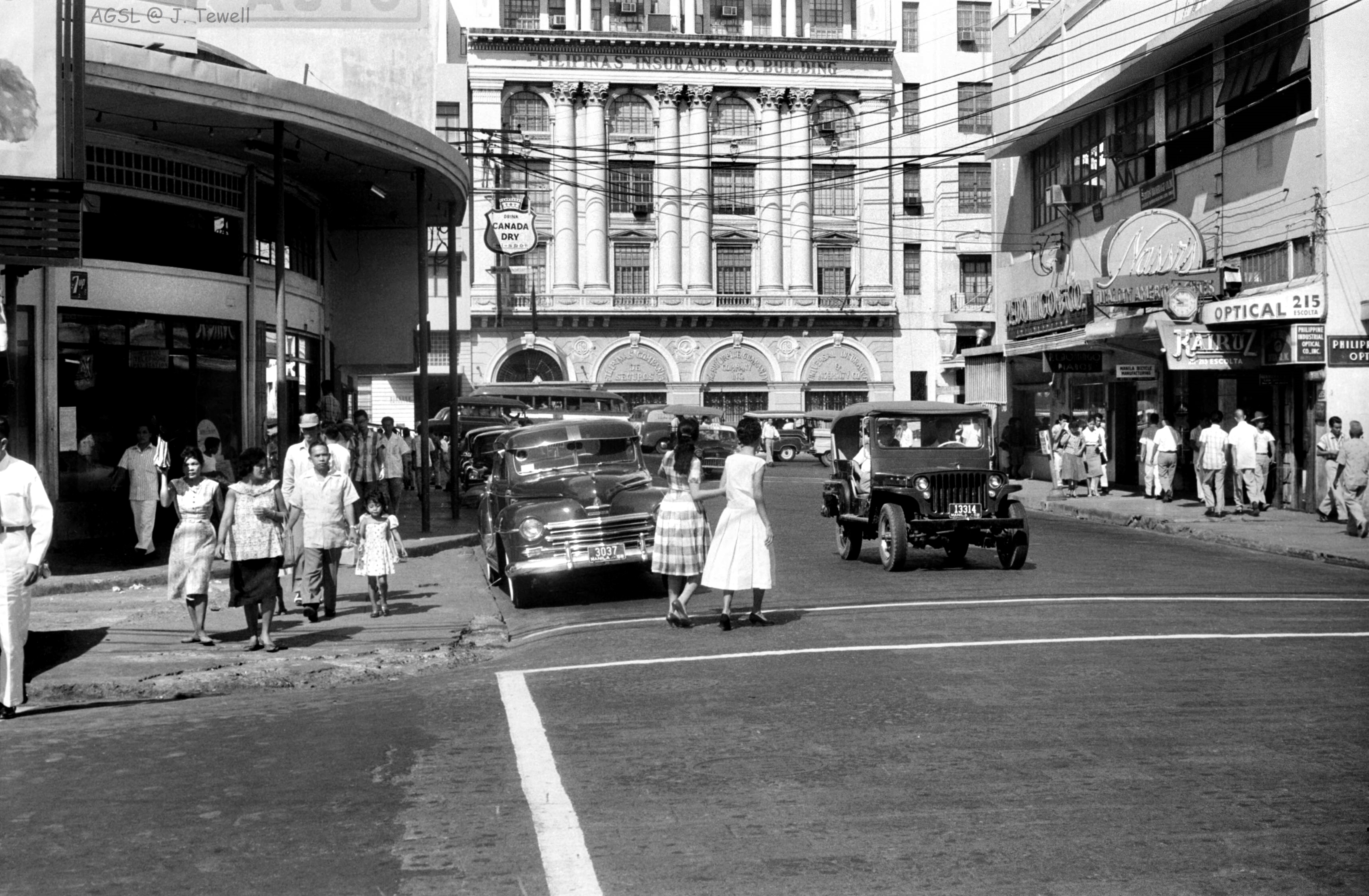
courtesy of J. TewellEscolta 1953-Insular Life bldg (courtesy J.Tewell)
Escolta 1953-Insular Life bldg in the background


My first car a 1947 Lincoln 76H Sedan with it's 292c.i. 2BBL 125 H.P. Flat Head V-12, 3 Speed Manual Transmission,  Stock Rear Axle & Gear Ratio. The video above is  the same as my first car. Like any boys yearning to have his wheels and freedom, I learned  to drive at the age of 14 barely reaching the gas pedal and my head above the dashboard. Later I bought the car from my father at the measly sum of 100 pesos.


Coast Guard Cutter in the Port Area, similar to ships we used  to patrol offs


Remnants of Daniel Burnham's stamp in Manila - the old Dewey Blvd. - now Roxas Blvd. Driving through the boulevard feels like driving through Chicago's Lake Shore Drive ... This picture of the boulevard feels like it was taken from a highrise on Chicago's Lake Shore Drive near Goethe and Inner Drive. The US Embassy is situated along this boulevard around the area of the lights jutting into the bay.

Remnants of Daniel Burnham's stamp in Manila - the old Dewey Blvd. - now Roxas Blvd. Driving through the boulevard feels like driving through Chicago's Lake Shore Drive ... Actually Burnham designed plans for Manila (1905) before he designed Chicago (1909). Parts of the design, based on the City Beautiful movement were implemented - like this boulevard along Manila Bay. He also designed Baguio City, the summer capital of the Philippines, situated up in the mountains of Northern Philippines.


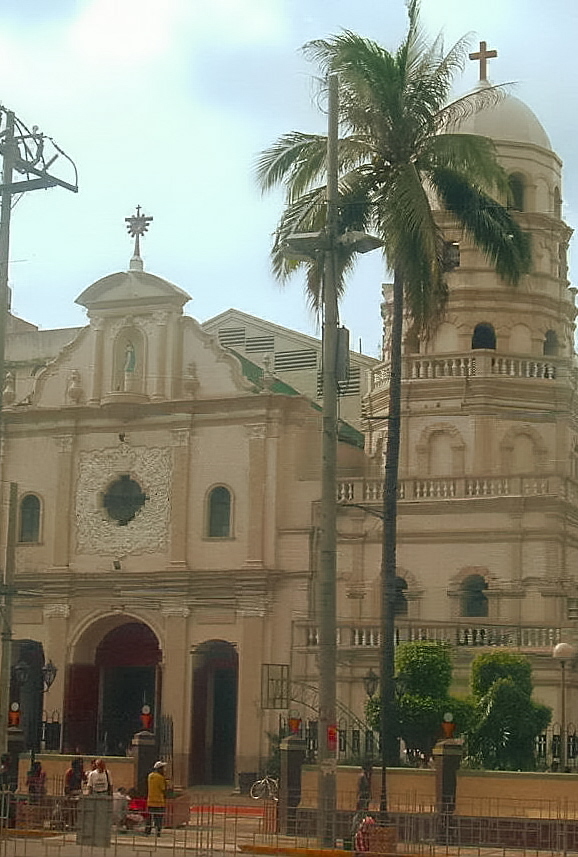
Espirito Santo Church

The place where the parish church of Espiritu Santo stands now was an old cemetery, officially closed by the Sanitary authorities already in 1913 due to the growing population in the vicinity. (There was a tree that served as an improvised belfry; on its branch hanged a bell. The two young seminarians studying at CTS, Juan Tugadi and Tomas Pacano, used to climb it to ring the bell. The two later became SVD priests.)
In January 1926, Archbishop Michael O.Doherty of Manila blessed the place where a church dedicated to the Holy Spirit was soon to rise. His Excellency gave a substantial donation for the construction of the church in the amount of P20,000.00. In 1928 our SVD missionaries started the construction of a church building. When Fr. William Finnemann was consecrated Auxiliary Bishop of Manila in 1929, Fr. Philip Beck took over as parish priest in December of 1931 - to him fell the burden of continuing the construction of the church. A crypt which contained 444 niches was built underneath the altar. The niches were sold to local residents and the proceeds used for the completion of the church. After much sacrifice and support from generous benefactors, parishioners and friends, the church was finally finished. It was blessed on the occasion of the parish fiesta on May 14, 1932 by Bishop William Finnemann himself - the first parish priest of Espiritu Santo Church.

February 9, 1946, the Capuchins obtained the official authorization from the government to restore the church of Lourdes in Intramuros. An official letter indicating the approval of the church and its condition, a plan of the church building was approved and signed on February 17, 1946. However, the Capuchins decided to build a beautiful and wide church in Quezon City, Retiro St. because Intramuros was a deserted place, abandoned by people and nobody’s land. The property of Intramuros where the Church of Lourdes and the Central House was sold to support the building of the new church at Quezon City.
Feast Day of Our Lady of Lourdes 1946 (Sta. Teresita Parish)


Espiritu Santo Church


photo

Altar at Our Lady of Lourdes retiro , Q.C

 One cannot mention the devotion to Our Lady of Lourdes in the Philippines without citing the people behind the devotion. It was a layman Don Regino Garcia who ordered the Filipino sculptor Manuel Flores to make a statue of Our Lady of Lourdes, which was placed at the side altar of the church of the Capuchins in 1892.
March of the same year, the capuchins with the help of Fr. Mc Carthy, an Augustinian priest, brought the image of Lourdes to the University of Santo Tomas. During Palm Sunday of the same year, the image of saints are covered with veils by the Dominicans including the image of Lourdes and handed it over to the Capuchins and carried it to the chapel of Santa Teresita for the celebration of Flores de Mayo.


It was during the Novena at Our Lady of Lourdes when the Japanese ordered all residents of Intramuros to go out of their houses and gather together at the four (4) main places of Intramuros: the Hollywood Theater, the San Agustin Church, the San Francisco Church and the Cathedral. Our Virgin of Lourdes and all the most necessary things were transferred from to altar to the receiving room of the convent of San Agustin Church. On February 11, the Feast of the Virgin of Lourdes, the capuchins and devotees appealed to the Japanese for permission to say 3 masses in the sacristy. The permit was granted, allowing 3 Superiors celebrating 3 masses for the feast: Franciscans, Augustinians and the Capuchins. How was the image of Lourdes was saved during the war?
Many people especially the devotees of Lourdes cried out to the capuchins to see the beautiful Virgin of Lourdes wondering how it was saved. According to history, when the capuchin brothers abandoned the church of Lourdes, Intramuros and the central house, they carried with them the image of Lourdes. Some days later, the Capuchin Custos, ,Fr. Florencio of Lezaun, gathered all religious articles: chalices, ciboriums, monstrances, relics and the treasure of the Virgin of Lourdes: crowns, rosaries and jewels. All together they put in iron box at the bank of D. Raimundo Salonga in Binondo. For the refuge of the Capuchin brothers, they were ordered by their superior to go to San Agustin and placed the images of Lourdes in the wide sacristy of the church. They continued on the daily novena exercises together with the religious of other orders and devotees including Doña Martina Azucena who was miraculously cured in 1896 before the image of Our Lady of Lourdes.
On February 23 of the same year, the image of Lourdes was abandoned in the sacristy of St. Augustine. Men young and old and the religious were horribly massacred by the Japanese sometime between January 5-19. Around 3500 women and children and all other refugees of St. Augustine were ordered to abandon the building.


Lourdes Church FacadeOL of Lourdes Fiesta 2010, OL of Lourdes Shrine, Amoranto Ave., Q.C., Philippines

photo

Portal to Old San Lazaro Hospital RuinsShrine of St. Lazarus, Avenida Rizal cor. Tayuman, Manila, Philippines


San Beda Church (Manila) A Swedish architect, George Asp, designed the church that was completed in 1925. Fr. Peter Celestine Gusi (OSB) later added the side chapels and galleries between 1947 and 1958

photo

San Beda Church (Manila)The church is reknowned for its paintings that were done by Fr. Lesmes Lopez (OSB) and Bro. Salvador Alberich (OSB) from 1930 until 1939.

Right Photo San Beda Church (Manila) A closer view of the main altar.
photo


Old San Lazaro Hospital Ruins. Shrine of St. Lazarus, Avenida Rizal cor. Tayuman, Manila.

The Manila Jai Alai Building was a building designed by American architect Welton Becket that functioned as a building for which jai alai games were held.[1] It was built in the Streamline Moderne style in 1940 and survived the Battle of Manila. It was considered one of finest Art Deco buildings in Asia. It was demolished on 2000 upon the orders of the Mayor of Manila Lito Atienza amidst protests, to make way for the Manila Hall of Justice, which was never built

Summer of 1950 sparked the beginning of the Korean War. As a police action the United Nations sent 16 member nations to uphold peace and democracy in South Korea. One of these countries was the Philippines who arrived in September of 1950. Very little is known about the Philippines' participation in the Korean War, let alone the soldiers who fought for democracy. These are their memories, the memories of the Forgotten.
Jai Alai structure on Taft Avenue, photo at the right and below.
photo

Old San Lazaro Hospital Ruins Shrine of St. Lazarus, Avenida

 Rizal cor. Tayuman, Manila


photo


Paco Park ( Manila). Visita Iglesia during vacation in the Philippines. Paco Park's Chapel of San Pancratius is where the remains of Spanish colonial Governor General Ramon Solano was interred. The park was originally designed by Nicolas Ruiz as a cementery of the Spanish colonial elite. It was built in the later years of the 1700s making it one of the oldest, if not the oldest, cementery in the Philippines. The GOMBURZA martys- Fr. Mariano Gomez, Fr. Jacinto Zamora, and Fr. Jose Burgos- were buried here after their execution in 1872. Twenty-four years later in 1896, the executed Dr. Jose Rizal was also secretly buried in the cemnetery. His remains were later exhumed in 1912 and moved to what his now his grand monument at the Luneta. Interment in the cementery was probihited in 1912 and most of the remains of those who were buried were moved out. The cementery became a national park in 1966.

Paco Park, Manila. A cross now marks the burial site of the GOMBURZA martys inside the park.

Paco Park (Manila) Dr. Jose Rizal was secretly buried in the park after his execution. His remains were later exhumed and interred beneath the Rizal Monument at the Luneta.


photo

San Juan, Metro Manila. Unique to the San Juan church is the massive buttress walls covering its facade. Butress walls are usually the side walls in the case of most Philippine colonial churches.

San Juan, Metro Manila. The Dominicans built the first parochial buildings in 1602 that were razed during the 1639 Chinese revolt. These were rebuilt in 1641, burned down during the British invasion of 1763, and rebuilt again in 1774. The city of San Juan is unofficially the "Town of Philippine Presidents" having had 5 Filipino presidents as residents namely Diosdado Macapagal and his unpopular daughter Gloria Macapagal-Arroyo, Ferdinand Marcos, Joseph Estrada, and Elpidio Quirino.

San Miguel, Manila. The Jesuits probably built the first parochial structures during their administration of the San Miguel ecclesiastical district in 1603 until 1768. The Franciscans took over the mission in 1777 and in 1835, Fr. Esteban Mena (OFM) was reported to have started building a church. Fr. Francisco Febres (OFM) made repairs and improvements after the 1852 earthquake. The church was destroyed during the 1880 earthquake and rebuilt by Fr. Emilio Gago (OFM) in 1886. It was rebuilt IN 1913 through the patronage of the Roxas clan and was sedignated by Msgr. Michael O’Doherty as a Pro-cathedral of the Archdiocese of Manila after it was inaugurated in 1913.


Paco Church, Manila. The Franciscans built the first parochial buildings of light materials in 1580 that was probably rebuilt with stronger materials in 1599 by Fr. Juan de Garrovillas (OFM). This was burned down during the Chinese uprising of 1603, rebuilt, burned down again by the invading British in 1762, and replaced with a temporary structure in 1791. Fr. Joaquin Segui (OFM) who built a stone convent in 1793 probably built another church. A new stone church was started to be built by Fr. Bernardo dela Concepcion (OFM) in 1809 while Fr. Miguel Richar (OFM) added a bell tower in 1839. The church was probably damaged during the 1852 earthquake, repaired, then destroyed during another earthquake in 1880. Fr. Gilberto Martin started rebuilding the church in 1881 that was partly destroyed by a typhoon in 1892 before being completed 1896. This was razed during the Filipino-American War and, in 1909, a temporary church was built beside the ruins of the old one by the Belgian missionary Fr. Raymundo Esquinet of the Congregatio Immaculatie Cordis Mariae (CICM). The present church was started to be built by Fr. Godofredo Aldenhuijsen (CICM) in 1931 based on the proposal of Fr. Jose Billie (CICM). It was damaged during World War II and repaired in 1948.


     University of the Philippines at Diliman
    photophoto

    The Volcano Taal is one of the Philippines' active volcanoes and has also been regarded as one of the smallest in the world. It's situated in the middle of Lake Taal in Batangas. Perhaps what makes this volcano unique is that a lake has also formed in its main crater, so you can say there's a lake within a lake.


    Left Photo. Mayon Volcano, also known as Mount Mayon, is an active stratovolcano in the province of Albay, in the Bicol Region, on the island of Luzon, in the Philippines.It has a perfect cone shape; It was named after a legendary folk Daragang magayon. It was among the 7 wonders of nature in the Philippines.


    1

    Jones Bridge, Probably one of the most romantic 

    bridges in the Philippines because of the stories it 

    can tell about Manila as it crosses towards 

    enchanting Chinatown and the once legendary business

     district. Built in honor of the American politician 

    that passed a bill trying to grant independence to the 

    Philippines during the 1920's.……………

    University of Sto. Tomas is the oldest school in the 

    Philippines. It was founded in 1611 and prides itself 

    to be even older than Harvard.

    photo

    Plaza Moraga


    San Lazaro Leisure Park Race Track


    San Lazaro Leisure Park Race

    The Jesuits built the first Roman Catholic Church in the area where the present Santa Cruz Parish stands on June 20, 1619. The Jesuits enshrined the image of the Our Lady of The Pillar in 1643 to serve the pre-dominantly Chinese residents in the area. The image drew a lot of devotees and a popular cult grew around it. On June 24, 1784, the King of Spain gave the deeds to about 2 km² of land that was part of the Hacienda de Mayhaligue to the San Lazaro Hospital which served as a caring home for lepers in Manila at that time. At the Santa Cruz Parish, a small park was built that linked the area into the headquarters of the Spanish cavalry, the building that once was the College of San Ildefonso, operated by the Jesuits. The district in the Spanish times also had a slaughter house and a meat market and up north was the Chinese cemetery. The Franciscan fathers were given the responsibility to care for the lepers of the city and specifically the San Lazaro Hospital. A Fr. Felix Huertas developed San Lazaro into a refuge for the afflicted and it became a famous home for those afflicted in the north side of the Pasig River.
    File:Sta. Cruz Church Manila.jpg 
    The Philippine General Hospital located on Taft Avenue beside my High School at Padre Faura was a public hospital but regardless was fortified by the Japanese in violation of the Geneva Convention.  Inside there were many Filipino patients and several thousand Filipino refugees that were seeking what they thought would be safe shelter. On the roof on both ends there were large white circles with large red crosses. From Feb. 14 to Feb. 17, 1945 the Americans shelled the area. Some of the shells hit the buildings and many innocent Filipinos were injured and many lives were lost. Notice that the right end of the building was hit with an exploding shell. And notice a hole through the roof on the left end of the building in the white circle area close to the red cross where a shell hit but did not explode.
    Tutuban Railroad Station
    The construction of a railway line traversing the island of Luzon was initiated according to a plan submitted by Don Eduardo Lopez Navarro, then head of the Public Works Office. The line stretches from Tondo, Manila to Dagupan, Pangasinan. On July 31, 1887, the cornerstone of the Tutuban Station was laid by General Emilio Terrero, marking the start of the railroad track.
    When the PNR began its operations on November 24, 1892, Tutuban Station became a place of business. It opened its doors to businessmen coming from different parts of Manila. Commerce played a large role in awareness about Tutuban, and it served as an important trading complex due to its very strategic location in Divisoria. Produce coming in by bulk from several provinces are unloaded in the station, and then distributed to retailers awaiting at the station.
    The etymology for the name “Tutuban” was believed to have come from the sounds made by the locomotives stationed in the area. However, the word actually comes from “tuba,” the name of the local alcoholic drink made from coconuts, since previously Tutuban was the center of production of this beverage. Natives referred to the place as Tubaan ... meaning a place where the "tuba" (native alchoholic beaverage) came from.
    Tutuban Station is also famous for being the birthplace of the revolutionary Andres Bonifacio. In commemoration, a monument stands in the current mall's plaza.


    photo
     Tanay Lighthouse


    RIZAL'S LAST FAREWELL
    Farewell, dear Fatherland, clime of the sun caress'd
    Pearl of the Orient seas, our Eden lost!,
    Gladly now I go to give thee this faded life's best,
    And were it brighter, fresher, or more blest
    Still would I give it thee, nor count the cost.


    On the field of battle, 'mid the frenzy of fight,
    Others have given their lives, without doubt or heed;
    The place matters not-cypress or laurel or lily white,
    Scaffold or open plain, combat or martyrdom's plight,
    T is ever the same, to serve our home and country's need.


    I die just when I see the dawn break,
    Through the gloom of night, to herald the day;
    And if color is lacking my blood thou shalt take,
    Pour'd out at need for thy dear sake
    To dye with its crimson the waking ray.


    My dreams, when life first opened to me,
    My dreams, when the hopes of youth beat high,
    Were to see thy lov'd face, O gem of the Orient sea
    From gloom and grief, from care and sorrow free;
    No blush on thy brow, no tear in thine eye.


    Dream of my life, my living and burning desire,
    All hail ! cries the soul that is now to take flight;
    All hail ! And sweet it is for thee to expire ;
    To die for thy sake, that thou mayst aspire;
    And sleep in thy bosom eternity's long night.


    If over my grave some day thou seest grow,
    In the grassy sod, a humble flower,
    Draw it to thy lips and kiss my soul so,
    While I may feel on my brow in the cold tomb below
    The touch of thy tenderness, thy breath's warm power.


    Let the moon beam over me soft and serene,
    Let the dawn shed over me its radiant flashes,
    Let the wind with sad lament over me keen ;
    And if on my cross a bird should be seen,
    Let it trill there its hymn of peace to my ashes.


    Let the sun draw the vapors up to the sky,
    And heavenward in purity bear my tardy protest
    Let some kind soul o 'er my untimely fate sigh,
    And in the still evening a prayer be lifted on high
    From thee, 0 my country, that in God I may rest.


    Pray for all those that hapless have died,
    For all who have suffered the unmeasur'd pain;
    For our mothers that bitterly their woes have cried,
    For widows and orphans, for captives by torture tried
    And then for thyself that redemption thou mayst gain.


    And when the dark night wraps the graveyard around
    With only the dead in their vigil to see
    Break not my repose or the mystery profound
    And perchance thou mayst hear a sad hymn resound
    'T is I, O my country, raising a song unto thee.


    And even my grave is remembered no more
    Unmark'd by never a cross nor a stone
    Let the plow sweep through it, the spade turn it o'er
    That my ashes may carpet earthly floor,
    Before into nothingness at last they are blown.


    Then will oblivion bring to me no care
    As over thy vales and plains I sweep;
    Throbbing and cleansed in thy space and air
    With color and light, with song and lament I fare,
    Ever repeating the faith that I keep.


    My Fatherland ador'd, that sadness to my sorrow lends
    Beloved Filipinas, hear now my last good-by!
    I give thee all: parents and kindred and friends
    For I go where no slave before the oppressor bends,
    Where faith can never kill, and God reigns e'er on high!


    Farewell to you all, from my soul torn away,
    Friends of my childhood in the home dispossessed !
    Give thanks that I rest from the wearisome day !
    Farewell to thee, too, sweet friend that lightened my way;
    Beloved creatures all, farewell! In death there is rest !
     

    Rizal Park, Ermita. At the centre of it all is the 1913 bronze Rizal's monument situated a few metres away from the marker indicating the actual execution site. An honor guard is on duty 24 hours a day. Behind the monument, the original Spanish version of the poem "Mi Ultimo Adios" is engraved, along with translations in other languages. Rizal wrote this poem while imprisoned in his cell in Fort Santiago from November 3, 1896 to December 29, 1896. Many national dedication days are held in front of the Rizal monument. It is also where foreign leaders attend wreath-laying ceremonies during state visits.
    Located on the monument is the statue of the national hero, but also his remains. On September 28, 1901, the United States Philippine Commission approved Act No. 243, which would erect a monument in Luneta to commemorate the memory of Jose Rizal, Philippine patriot, writer and poet. The committee formed by the act held an international design competition between 1905–1907 and invited sculptors from Europe and the United States to submit entries with an estimated cost of 100,000 peso’s using local materials.


    Monte de Piedad Building in Sta. Cruz.
    photo

    One of the older buildings in the Sta. Cruz area is the quite inconspicuous building of Monte de Piedad. It is just beside the Filipino Chinese Friendship arch at the end of Ongpin Street in Sta. Cruz district. Monte de Piedad is considered as the Philippines first savings bank having been established in 1882. The bank was established to cater to the financial needs of the poor. What’s more, the Catholic Church of the Philippines had strong ties to this bank, in fact the chairman of the board is usually the Archbishop of Manila.


    Taken from Fort Santaigo, Fort Santiago is a citadel first built by Spanish conquistador, Miguel López de Legazpi for the new established city of Manila in the Philippines. The defence fortress is part of the structures of the walled city of Manila called Intramuros ( within the walls ). The fort is one of the most important historical sites in Manila. Several lives were lost in its prisons during the Spanish Colonial Period and World War II. José Rizal, the Philippines' national hero, was imprisoned here before his execution in 1896. The Rizal Shrine museum displays memorabilia of the hero in their collection and the fort features, embedded onto the ground in bronze, his footsteps representing his final walk from his cell to the location of the actual execution. The fort was named after Saint James the Great ( Santiago in Spanish ), the patron saint of Spain, whose relief adorns the facade of the front gate. It is located at the mouth of the Pasig River and served as the premier defence fortress of the Spanish Government during their rule of the country. It became a main fort for the spice trade to the Americas and Europe for 333 years. The Manila Galleon trade to Acapulco, Mexico began from the Fuerza de Santiago.

    The fort has a perimeter of 2,030 feet ( 620 m ), and it is of a nearly triangular form. The south front, which looks toward the city, is a curtain with a terreplein, flanked by two demi-bastions - the Bastion of San Fernando, on the riverside, and the Bastion of San Miguel, by the bay side. A moat connected with the river separates the fort from the city. Near the beginning of the north face, instead of a bastion, a cavalier called Santa Barbara was built with three faces of batteries, one looking seaward over the anchorage place, one facing the entrance, and the third looking upon the river. The latter is united with a tower of the same height as the walls, through which there is a descent to the water battery placed on a semicircular platform, thus completing the triangular form of the fort.
    The 22-foot ( 6.7 m ) high walls, with a thickness of eight feet ( 2.4 m ) are pierced for the necessary communications. The front gateway facade measures 40 feet ( 12 m ) high being in the south wall and facing the city. The communication with the river and the sea was by an obscure postern gate - the Postigo de la Nuestra Señora del Soledad ( Postern of Our Lady of Solitude ). Inside the fort were guard stations, together with the barracks of the troops of the garrison and quarters of the warden and his subalterns.
    photo
    Ferry, Pasig river.Makati, Manila,

    Also inside the fort were various storehouses, a chapel, the powder magazine, the sentry towers, the cisterns, etc. The location of Fort Santiago was once the site of a palisaded fort, armed with bronze guns, of Rajah Sulaiman, a Muslim chieftain of pre-Hispanic Manila. It was destroyed by maestre de campo ( master-of-camp ) Martin de Goiti who, on arriving in 1570 from Cebu, fought several battles with the Islamic natives. The Spaniards started building Fort Santiago ( Fuerza de Santiago ) after the establishment of the city of Manila under Spanish rule on June 24, 1571, and made Manila the capital of the newly colonized country.
    The first fort was a structure of palm logs and earth. Most of it was destroyed when the city was invaded by Chinese pirates led by Limahong. Martin de Goiti was killed during the siege. After a fierce conflict, the Spaniards under the leadership of Juan de Salcedo, eventually drove the pirates out to Pangasinan province to the north, and eventually out of the country. The construction of Fort Santiago with hard stone, together with the original fortified walls of Intramuros, began in 1590 and finished in 1593 during the reign of Gomez Perez Dasmariñas. The stones used were volcanic tuff quarried from Guadalupe ( now Gualupe Viejo in Makati ). The fort as Dasmariñas left it consisted of a castellated structure without towers, trapezoidal in trace, its straight grey front projecting into the river mouth. Arches supported an open gun platform above, named the battery of Santa Barbara, the patron saint of all good artillerymen. These arches formed casemates which afforded a lower tier of fire through embrasures. Curtain walls of simplest character, without counter forts or interior buttresses, extended the flanks to a fourth front facing the city.


    Tanay San Ildefonso Church


    Bomod-ok Falls. Sagada, Mt. Province, Philippines


    Curvy Road over Mt. Province


    Plaza Sta Cruz. Prior to the arrival of the Spanish conquistadors to the Philippine Islands, the district of Santa Cruz was partly a marshland, patches of greeneries, orchards and partly rice fields. A Spanish expedition in 1581 claimed the territory and awarded to the Society of Jesus or more commonly called the Jesuits


    photo
    photo

    Manila Cathedral


    Regina Building. This building is one of the few American Era buildings that remained along Calle Escolta. Regina bldg. right photo.


    Roman Santos Building


    The Heritage Bells, the bigger one cast in 1832, the other one fifty years later, were once used to signal the start and end of classes at the Ateneo de Manila campuses in Intramuros and Padre Faura St. During my High School days, the basket ball court at Ateneo was always our venue, most probably due to the trees which shaded the court. The Padre Faura campus continued to house the professional schools until 1976. Fr. Francisco Araneta, S.J. was appointed as the Ateneo de Manila's first Filipino Rector in 1958. In 1959, its centennial year, the Ateneo became university.

    The Escolta I remember

    Plaza Moraga. I remember passing this way before ... I just could not determine if this is the foot of the the Jones Bridge.


    Jeepney Surplus US jeep converted into a mini-bus, painted fancy, seats 10 plus driver. Five cents to ride from suburbs to downtown Manila
    photo
    Houseboats on the Pasig amid Nila plants. Hence the name, Manila is part of the Pacific Ring of Fire and is jostled regularly by earthquakes.
    photo

    Escolta


    Manila Harbor,  and Intramuros, Philippines, late 1950s or early 1960s. Notice that this photo was taken before much rebuilding in Intramuros and there is lots of empty land showing just how much of the city was cleared after WWII.


    Papa as a young Ensign on training attached to the US Navy

    Customs Building, Port Area, Manila

    Port Area Manila

    Which ever way ...Different kinds of transportation to bring in and bring out people to and from the island of Cebu in the Philippines.

    Coast Guard Port Area Manila

    End of Day Sun just about to disappear from the horizon. The ship on the foreground is the PMI training ship.


    Luzon, Sagada is nestled in a valley at the upper end of the Malitep tributary of the Chico River some one and a half kilometers above sea level in the central Cordillera; enveloped between the main Cordillera Ranges and the Ilocos Range. Mt. Data in the south and Mt. Kalawitan in the southeast pierce the horizon. Mt. Polis, Bessang and Mt. Tirad in the east, and Mt. Sisipitan in the north mark the Mountain Province - Abra boundary.

    Kalinga-Apayao Province


    The Banaue Rice Terraces (Tagalog: Hagdan-hagdang Palayan ng Banawe) are 2000-year old terraces that were carved into the mountains of Ifugao in the Philippines by ancestors of the indigenous people. The Rice Terraces are commonly referred to by Filipinos as the "Eighth Wonder of the World". It is commonly thought that the terraces were built with minimal equipment, largely by hand. The terraces are located approximately 1500 meters (5000 ft) above sea level and cover 10,360 square kilometers (about 4000 square miles) of mountainside. They are fed by an ancient irrigation system from the rainforests above the terraces. It is said that if the steps are put end to end it would encircle half the globe.

    Contrary to popular belief, the Banaue Rice Terraces are not part of the Rice Terraces of the Philippine Cordilleras UNESCO inscription but are declared a National Cultural Treasure as the Ifugao Rice Terraces. Ancient sprawling man-made structures from 2,000 to 6,000 years old, other terraces are found in the provinces of Kalinga, Apayao, Benguet, Mountain Province and Ifugao. But only those in Batad, Bangaan, Mayoyao, Hungduan and Nagacadan, all in Ifugao, are inscribed as a UNESCO World Heritage Site.
    photo

    battery grudds Corregidor


    Eisenhower visit. I was there observing the motorcade as a sophomore at U.P. Prep. Luneta below. 
    This was the Luneta I remember ... I was in my 2nd year High School at the University when 
    "Ike" visited the Philippines. ... of course Ike used to live here before the 2nd WW when 
    Philippines was a Commonwealth of the United States and was aid to the Field Marshal ...now 
    President of the USA.

    Funeral practices and burial customs in the Philippines encompass a wide range of personal, cultural, and traditional beliefs and practices which Filipinos observe in relation to bereavement, dying, honoring, respecting, interring, and remembering their departed loved ones, relatives, and friends. Sources of the various practices include religious teachings, vestiges of colonialism, and regional variations on these.

    In the past and in present times, Filipinos believe in the afterlife and give attention to respecting and paying homage to dead people. Wakes are generally held from 3 to 7 days. Provincial wakes are usually held in the home, while city dwellers typically display their dead at a funeral home. Apart from spreading the news about someone’s death verbally, obituaries are also published in newspapers. Although the majority of the Filipino people are Christians, they have retained superstitious beliefs concerning death.

    Hanging coffins are coffins which have been placed on cliffs. They can be found in various locations, including China and the Philippines. In China, they are known as Xuanguan which also means "hanging


     coffin".


    Kalinga (Tagalog pronunciation: [kɐˈliŋɐ]) is a landlocked province of the Philippines in the Cordillera Administrative Region in Luzon. Its capital is Tabuk and borders Mountain Province to the south, Abra to the west, Isabela to the east, Cagayan to the northeast, and Apayao to the north. 


    Sagada


    Banaue Luzon Kalinga-Apayao Provinc Kalinga (Tagalog pronunciation: [kɐˈliŋɐ]) is a landlocked province of the Philippines in the Cordillera Administrative Region in Luzon. Its capital is Tabuk and borders Mountain Province to the south, Abra to the west, Isabela to the east, Cagayan to the northeast, and Apayao to the north. Prior to 1995, Kalinga and Apayao used to be a single province named Kalinga-Apayao, until an ethnic/tribal war prompted separation


    Ifugao kids Ang mga Igorot ay isang grupong etniko sa Pilipinas. Matatagpuan sila sa Cordillera, sa isla ng Luzon, sa hilaga ng bansa. Mayroong anim na lalawigan sa Cordillera Administrative Region (CAR): ang Abra, Apayao, Benguet, Ifugao, Kalinga, at Mountain Province. Nag-iisang lungsod sa CAR ang lungsod ng Baguio. May anim na etnolinggwistikong grupo sa parte ng mga pook na tinitirhan ng mga Igorot: ang Bontoc, Ibaloi, Ifugao, Isneg (o Apayao), Kalinga, at Kankanaey. Ang mga Igorot ay kilala sa kanilang pagiging masipag, matatag, at tapat sa kanilang pinagmulan. Mga ugaling hindi basta basta hinahayaang makuha ng iba ang kanilang mga namana o nakuhang mga kayamanan.

    Mahalaga sa kanila ang lupa, sapagkat ito ang pangunahing ikinabubuhay nila. Ang isang patunay nito ang Hagdan-hagdang Palayan ng Banawe na matatagpuan sa isang tribu sa Ifugao.


    The walk from the road down to the village and back up takes no longer than 1 ½ hours. Much of the walk is through rice fields, so take shelter from sun and rain. The village has become an historic sight, with many traditional houses still standing. Souvenir shops have been set up by the locals and some provide coffee, cold drinks (even beer) and shelter from the rain. We chose hot coffees and were entertained by Conchita at her outdoor tables. We found her conversation so interesting and informative that we stayed for more coffee and finally a beer. I bought one of the excellent knives manufactured by a local blacksmith. He uses steel from old car springs and mounts the pieces in a wooden sheath, bound with rattan, as is the knife handle.


    battery crockett


    1945-2005-escolta


    CHINA TOWN
     

    AT LIPA LAGUNA  ANCIENT DISCOVERIES (709,000 years old) ON OUR WAY TO LOS BANOS


    Beyond Human's wildest hopes, the Philippines is home to a wealth of archeological discoveries that have revolutionized our knowledge of human history. Right from the finding of mutilated rhinoceros bones in the Philippines, which casts doubt on the current knowledge of the 709,000-year-old human migration across Asia, to the amazing finding of the homo Luzonensis fossils in the Philippines, which serve as evidence of the worldwide archaeologists' cooperative efforts. There are lots of terrifying findings about the Philippines that have changed its status quo. What brought about the discovery of the Angono petroglyphs? Let’s find out. Scientists have exquisitely traced the evolution of the Philippines into existence to about 709,000 years ago, with the earliest known human activity in the archipelago. At this intriguing period, the Island of Luzon was once home to the extinct human species Homo Luzonensis, at least 67,000 years ago. The first anatomically modern Human was found at the Tabon Caves in Palawan approximately 47,000 years ago. Amazingly, research revealed that the Negrito clans were the first people to settle in the ancient Philippines. Following them were Asiatics, Papuans, and South Asians. Maritime Austronesians, who migrated southward from Taiwan in 3000 BC, make up most of the current population. By 2000 B.C., the archipelago served as the hub of a Trans-Oceanic Philippine jade culture. discovery,unexplained,mysterious,top 10,top 15,space,universe,science,techology,mystery,facts,interesting,discovery channel,discovery plus,scientists discovery,aliens,ufo,terrifying discoveries,top,they discovered,invention,future,galaxy,james webb,elon musk,business,entertainment,Uncovered Files,betelgeuse,space news,universe news,largest underwater volcano has suddenly cracked open the earth,yellowstone volcano,terrifying discovery,volcano,


    We stumbled at this little town of lipa Laguna not knowing the significance of this place in the history of the Philippines. Brace yourselves for a jaw-dropping revelation that will shatter everything you thought you knew about the Philippines. This is not your typical travel brochure tale; it's a mind-blowing journey into a realm of scientific discovery that will leave you questioning the very fabric of history. Are you ready to uncover the secrets hidden in the heart of Southeast Asia? Buckle up because what we're about to reveal will send shockwaves through your understanding of this tropical paradise. Nestled amidst over 7,600 islands, the Philippines has long been celebrated for its diverse beauty and captivating charm. From world-renowned beaches to lush mountain landscapes, it's a tropical haven like no other. But beneath its surface lies a secret that has the scientific community buzzing with excitement. Forget the stereotypes; this isn't just about karaoke and street basketball. Beyond its economic rise and territorial disputes, the Philippines conceals a treasure trove of archaeological wonders that rewrite the narrative of human history.


    Frequently, it is stated that the Philippine's history is commonly associated with foreign colonization. There are limited historical records that document the diverse culture of the indigenous Filipinos before the arrival of the Spanish. Nevertheless, archaeological findings, such as the evidence of rhino butchering and the discovery of Homo Luzonensis, provide compelling proof that ancient humans had already inhabited the country thousands of years ago.


    Pre-Hispanic period

    Before the first arrival of Europeans on Luzon island, the island was part of the Majapahit empire around the 14th century, according to the epic eulogy poem Nagarakretagama which described its conquest by Mahārāja Hayam Wuruk. The region was invaded around 1485 by Sultan Bolkiah and became a part of the Sultanate of Brunei. The site of Intramuros then became a part of the Islamic Kingdom of Maynila ruled by various Datus, Rajas and the Sultan.

    Construction of the defensive walls was started by the Spaniards in the late 16th century to protect the city from foreign invasions. The 0.67-square-kilometre (0.26 sq mi) walled city was originally located along the shores of the Manila Bay, south of the entrance to Pasig River. The reclamations during the early 20th-century obscured the walls from the bay. Guarding the old city is Fort Santiago, its citadel located at the mouth of the river. Intramuros was heavily damaged during the battle to recapture the city from the Japanese Imperial Army during the Second World War. Reconstruction of the walls was started in 1951 when Intramuros was declared a National Historical Monument, which is continued to this day by the Intramuros Administration

    Angeles del Pilar Samson……..1919-1994


    I have always regarded my mother as the most patient, gentle and beautiful person in my life. She was my model during my search for my future wife who will be NO LESS THAN MY MOTHER. As a little child I loved her most of all, now that I am old, my love for her has grown beyond this world. I terribly miss her presence and tender care.

    1


    Intramuros - Manila Hotel

    Intramuros is the oldest district and historic core of Manila, the capital of the Philippines. Known as the Walled City, the original fortified city of Manila was the seat of the Spanish government during the Spanish colonial period. The walled part of Manila was called intramuros, which is Latin for "within the walls"; districts beyond the walls were referred as the extramuros of Manila, meaning "outside the walls"

    The Manila Hotel which opened in 1912 and extensively remodeled in the 1970s is a Philippine landmark, home to high society and to political intrigue, and often a scene of historic events.
    1898- Judge William Howard Taft issued of the first decrees of the Second Philippine Commission, to create an urban plan for the Manila. Architect and city planner Daniel Hudson Burnham drafted a wide and long tree-lined boulevard that would begin at the park and at the spit’s end of the bay, a boulevard that would be dominated on one end by a hotel.
    1908- William Parsons was appointed to continue where Burnham left off. He supervised the design and construction of Manila Hotel and was completed four years later. Soon, a magnificent, white, green-tile-roofed California Missionary-styled edifice emerged housing 149 spacious and high-ceilinged rooms. Since then, it is a hotel that commands the best westward view of Manila’s fabled sunset, the fortress of Corregidor, the poignant ruins of the medieval fortress that was Intramuros, and the palm-lined promenades of Luneta Park.


    1
    In my late seventies, I begin to see the value of childhood memories, as a legacy worth sharing it to my family and that I, hopefully, will not be forgotten when I leave this physical world. 
    My consciousness started on a bright November day in 1946 at the age of two. I experienced my new relation with my sister Aleta newly arrived from the hospital the night before. On this early morning, while waking from deep sleep in the bedroom, I saw my mother and the new born baby. I stood up watched my sister take my place as the new “baby” supposed with the jealousy of a child wondering what his new status is. At a distance I could see my mother's pretty face nourishing my little sister, as I ran toward her. I can only imagine her smiling face filled with assurance to know how I felt, tinge with a fear of rivalry, little legs running toward her.
    Right photo, was taken one month before Aleta was born, bottom photo further down taken at graduation from Grade 7, March 17, 1957.


    O mother-my-love, if you’ll give me your hand,
    And go where I ask you to wander,
    I will lead you away to a beautiful land,–
    The Dreamland that’s waiting out yonder.
    We’ll walk in a sweet posie-garden out there,
    Where moonlight and starlight are streaming,
    And the flowers and the birds are filling the air
    With the fragrance and music of dreaming.

    There’ll be no little tired-out boy to undress,
    No questions or cares to perplex you,
    There’ll be no little bruises or bumps to caress,
    Nor patching of stockings to vex you;
    For I’ll rock you away on a silver-dew stream
    And sing you asleep when you’re weary,
    And no one shall know of our beautiful dream
    But you and your own little dearie.

    And when I am tired I’ll nestle my head
    In the bosom that’s soothed me so often,
    And the wide-awake stars shall sing, in my stead,
    A song which our dreaming shall soften.
    So, Mother-my-Love, let me take your dear hand,
    And away through the starlight we’ll wander,–
    Away through the mist to the beautiful land,–
    The Dreamland that’s waiting out yonder......EF


    No photo description available.

    MY ARTS TEACHER MS Viduya_Marita


    No photo description available.

    MY SCIENCE TEACHER MISS JULLIETA
     DAYAP


    In 1960: I became aware of my heritage in my junior year at UP Prep and began preparation for my appointment as a cadet at  PMA in Fort Del Pilar. This was a period in my teen years that I remember fondly, memories in my High School, of the hectic days, dashing thru the corridors catching my schedule of classes at Rizal Hall. I recall my bag loaded with books, eager, wide eyed, and quick to learn the tenets of math, the arts and sciences. I remember past friends and stormy situations that most teenagers weathered through. As in life surviving the unspoken pecking order among bigger classmates and the so called in crowd was the rule. That lone wolf streak that kept me apart, which peers seemed to see as a weakness was a measure of heritage that set me off from the current teenage precepts of the day. Later, when of age and after further studies, having ever spurred curiosity, whetted my appetite for a life of adventure, of soldiering and foreign lands.   


     TO MOM WITH ALL MY LOVE AND PRAYERS


    TO ALL MY LADY PROFESSORS ND  A SPECIAL MENTION TO Mr RUBIO ONLY


    June 1967: This photo courtesy of Rosalina D. Corbett, showing the oath taking of newly registered Chemical Engineers. Taken sometime June 24, 1967 in Makati, Sarmiento bldg. From far left is Jose Catibog, me, Reynaldo Santos, Maximillan Ui, Audie Vergara, Florencio Roxas, Lorna M. Jereza, Rosalina Derige Corbett, Oscar Santos, Rey Sequerra, Celso Chua, Romeo Olalia........................Alexander


    I graduated right in front of this building with class 1966 ChE and Carlos P. Romulo as guest speaker. The Institute is a reputable source of architects, engineers, and science graduates and constantly produces top notchers in the architectural and engineering fields. Photo below of the American Cemetery at the old Fort Bonifacio, where we lived close by.


    Chapel Sculpture Facade of the 60-ft tall chapel of the American Cemetery in Fort Bonifacio, Taguig City. The sculpture represents, from bottom to top, the young American warrior symbolized by St George, fighting his enemy, the dragon, in the jungle. Above them are the ideals for which he fought: Liberty, Justice, Country. Columbia, with the child symbolizing the future, stands at the zenith. Information sourced from the Manila American Cemetery and Memorial pamphlet.


    In 1951, the Mapúa family acquired a piece of land from the La Corporación Fransicana where the present Intramuros Campus stands. The campus opened at 1956 while the building construction were completed in 1963. All college programs were transferred from the Doroteo José campus to the Intramuros Campus in 1973. During my stay, the Institute consistently dominated the top 10 and even the top 20 slots in most licensure exams for architecture and engineering, year after year. It also consistently achieved the highest passing rates in the board exams among other competing schools in architecture and the various fields of engineering. The check marks represent the graduates who passed their CHEMICAL ENGINEERING BOARD EXAM. 


    File:Manila American Cemetery and Memorial.jpg


    High Noon at the Batttlefield

    Right hemicycle of the Manila American Cemetery, viewed from the entrance of the left hemicycle. The gap between the gray pebbles is the path to the memorial's chapel. For more information, please see

    In Memoriam

    Opposites

    Shot at the Manila American Cemetery. The brownish smooth hardness of the limestone tablets against the dark, disordered patterns of the tree's foliage. Order and disorder. Life. Gone, and the living.


    Wall of the Missing. Continuing with the B&W project. Shot at the Manila American Cemetery in Fort Bonifacio, Taguig City. As the sun gently sinks, the shadows slowly draws across the names of the missing valiant - exactly 36,286 American and Filipino servicemen are recorded in these limestone tablets.

    photo

    Manila American Cemetery and Memorial

    Manila American Cemetery and Memorial is located in Fort Bonifacio, Taguig City in Metro Manila, Philippines.
    photo

    Manila American Cemetery and Memorial


    Nave Chapel of Our Lady of the Miraculous Medal, Philippine Women's University, Manila, Philippines


    Pasig River viewed from old Ayala Bridge

    Puerta de Isabel Gate through the old Spanish Wall, Intramuros, Manila


    Puerta Postigo del Palacio Gate, Intramuros, Manila, Philippines

    photo 


    The awesome interior of old Binondo Church ( Basilica of San Lorenzo Ruiz ) .... the patroness of this historic Dominican Church is the Nuestra Senora Del Rosario .

    In College, I worked in this building with an export import company.


    File:American Memorial Cemetery Manila graves.jpg


    The cemetery, 152 acres (62 ha) or 615,000 square metres in area, is located on a prominent plateau, visible at a distance from the east, south and west. With a total of 17,206 graves, it is the largest cemetery in the Pacific for U.S. personnel killed during World War II, and also holds war dead from the Philippines and other allied nations. Many of the personnel whose remains are interred or represented were killed in New Guinea, or during the Battle of the Philippines (1941-42) or the Allied recapture of the islands. The headstones are made of marble which are aligned in eleven plots forming a generally circular pattern, set among masses of a wide variety of tropical trees and shrubbery.

     PROPERTY IN FRANCE FOR SALE BY OWNER   FOR $200,000 IN MONTAIGUT EN COMBRAILLE ( in the Puy-de-Dôme department of Auvergne)


    Renovattion of the house cost more than $ 120,000 ie. new roof $25,000, Brick Floors in family  room $36,000 , reinforoced dumgeons and new wood in living floor, arch dungeons floor  and spiral stairs $23,000, Finishing up like double pane windows, doors, utilities, $37,000, landscaping concrete work, $12,000 etc. Then antique furnitures, linen included. Living area of 2009 sq. feet, 3 bath and 3 bdr. Click here to see the full album of the house  FROM A MEDIEVAL HOME 


    As a child, I dream about traveling around the world especially in Europe and living there for for some months abd acquring their culture and language, I would need a house or a home base equidistant to the capitals of Europe. This dream was fulfilled later on above, in my retired years. However, I am done with traveling and will sell this house for a measely sum of $200,000 together with the antique fornitures, see  Inside the house


    This is the only restaurant that can compete with Auntie Auroring’s pancit mami


    photo


    Makati ... the facade of Sanctuario De San Antonio Church in Forbes Park ( Makati, Rizal ). My parish church at Fort Bonifacio back in the 1960s

    photoSan Beda College The facade of the Chapel of Our Lady of Montserrat ( San Beda College ) ( Mendiola Street, Manila )...... the primary institution of the Benedictine Order in the Philippines

    photo
    Altar at Sanctuario de San Antonio, Forbes Park


    1960: Pasig River still alive then, now heavy polluted and black in color. The Pasig River was a clear, flowing body of water that served as the center of commerce in Spanish colonial Manila. Stretching 27 kilometers, it connects Laguna Lake to Manila Bay and was the major source of water and livelihood of the many communities along its banks. People washed clothes in the shallower waters and fisher folks’ daily catch were always bountiful. The passenger boats that plied the river from the nearby province of Laguna to Manila and back served as the primary means of transportation. Today’s generation, however, has no recollection of the Pasig River in its heyday. Sunset at Manila Bay where the Pasig River empties. 


    The Pontifical and Royal University of Santo Tomas, The Catholic University of the Philippines (colloquially UST or "Ustê". Filipino: Unibersidad ng Santo Tomas), is a private Roman Catholic university run by the Order of Preachers in Manila. Founded on April 28, 1611 by archbishop of Manila Miguel de Benavides, it has the oldest extant university charter in the Philippines and in Asia. and is one of the world's largest Catholic universities in terms of enrollment found on one campus. UST is also the largest university in the city of Manila. Almost all the MD’s of the family graduated from UST. 


    Plaza Miranda-Quiapo 1950's-1970's Metro Manila

    Quezon Blvd.- Quiapo1950's-1970's Metro Manila,

    Rizal Theater-Makati 1950's-1970's Metro Manila, Philippines

    Palm Sunday

    Benediction every Monday afternoon. Our ritual at Espirito Santo Parochial School


    photo

    Centro Escolar University, Manila,

    FEU Right Photo

    photo

    st joseph's college


                       FEU -

    Typical corner cafe and street vendor up front.
    My parents married in this church in 1942.  The Roman Catholic Church  of San Ildefonso, in its eyes, a marriage is forged by God. The Church states that what God joins together, humans cannot sunder. I was also baptized in this church by Father Price, the arish


    Sagada, Mt. Province


    ABOVE MY TOURS OF WESTERN AND EASTERN EUROPE: As a child, I dreamt about traveling around the world especially in Europe and living there for for some months abd acquring their culture and language, I would need a house or a home base equidistant to the capitals of Europe. This dream was fulfilled later on above, in my retired years. However, I am done with traveling and will sell this house for a measely sum of $_00,000 together with the antique fornitures, see  Inside the house


    Pasay City,  Roxas Blvd. at Aristocrat (Barbecue Plaza)
     

    Del Pilar Shrine Marcelo H. Del Pilar Shrine in Bulakan, Bulacan.

      Gen. Gregorio  Del Pilar Shrine


    View from Old Intramuros prior to reconstruction, towards the Post Office Building and Santa Cruz Bridge from the ruins of Recolectos Church 1950s. Notice the grass and vegetation along the walls that we in our young days have to cut and clean.


    photo


    THE BOY GENERAL GREGORIO DEL PILAR

    My grand uncle General Gregorio del Pilar monument THE BOY GENERAL, HERO OF THE PHILIPPINE AMERICAN WAR


    Before I left for the US we visited Tagaytay for the last time. From the ridge, a magnificent view of Taal can be seen, and Taal lake as the picture above can be accessible by car from the main road.


    Taal volcano as seen from Picnic Grove on a cloudy day.

    Taal Volcano is a complex volcano. Historical eruptions are concentrated on Volcano Island, an island near the middle of Lake Taal. The lake partially fills Taal Caldera, which was formed by powerful prehistoric eruptions between 140,000 to 5,380 BP. Viewed from Tagaytay Ridge, Taal Volcano and Lake presents one of the most picturesque and attractive views in the Philippines. It is located about 50 km ( 31 miles ) south of the capital of the country, the city of Manila.
    The volcano had several violent eruptions in the past causing loss of life in the island and the populated areas surrounding the lake, with the death toll estimated at around 5,000 to 6,000. Because of its proximity to populated areas and its eruptive history, the volcano was designated a Decade Volcano, worthy of close study to prevent future natural disasters. It is one of the active volcanoes in the Philippines and part of the Pacific ring of fire.
    Taal Volcano and Lake are wholly located in the province of Batangas. The northern half of Volcano Island falls under the jurisdiction of the lake shore town of Talisay, and the southern half to San Nicolas. The other towns that encircle Taal Lake include Tanauan, Talisay, Laurel, Agoncillo, Santa Teresita, Alitagtag, Cuenca, Lipa, Balete and Mataas na Kahoy.


    Main Gate, Intramuros

    The site of Intramuros was originally a large Malayan-Islamic settlement named "Maynilad", ruled by three chieftains Rajah Sulayman, Lakan Dula and Rajah Matanda. The name came from "may nilad", "nilad" being a water plant whose star-shaped flowers clustered in abundance along the low-lying riverbanks. The strategic location of Maynilad, being on the Pasig River and the Manila Bay, made it an ideal location for indigenous Tagalog tribes to trade with other Asian civilizations, including Chinese and Islamic merchants who had come from China, Borneo and Indonesia. Maynilad was also the seat of power for native chiefs who ruled the area before Europeans first arrived in Luzon.
    In 1564, conquistadors led by Miguel López de Legazpi sailed from New Spain (Mexico) and arrived on the island of Cebu in February 13, 1565. There they established the first Spanish colony in the archipelago. Having heard of rich resources of Manila by local natives, López de Legazpi dispatched two of his Lieutenant-commanders, Martín de Goiti and Juan de Salcedo to explore the northern regions of the Visayas.
    In 1570, the Spaniards arrived in the island of Luzon. After quarrels had erupted between the Islamic natives and the Spaniards; Goiti and López de Legazpi's soldiers waged war on the people, before they were able to take control and establish a permanent settlement in the area. In 1571 after the natives were defeated in battle, López de Legazpi made a peace pact with Rajah Sulayman, Rajah Lakandula and Rajah Matanda; who, in return, handed over Manila to the Spaniards.
    Citing the rich resources and location of Manila; López de Legazpi declared the area as the new capital of the Spanish colony in the Philippines on June 24, 1571. The King of Spain, delighted at the new conquest achieved by López de Legazpi and his men, awarded the city a coat of arms and declaring it Ciudad Insigne y Siempre Leal ("Distinguished and ever loyal city").
    The planning of the city of Manila was commenced by López de Legazpi who had become the first Governor general on the islands. He established forts, roads, churches and schools. The plans for Intramuros were based on King Philip II's Royal Ordinance issued on July 3, 1573 in San Lorenzo, Spain. It's design was based upon a medieval castle structure and covered 64 hectares of land, surrounded by 8 metre thick stones and high walls that rise 22 metres.
    Intramuros was completed in 1606 and it served as the center of political, military and religious power of the Spaniards during the time that the Philippines was a colony of Spain. Inside Intramuros; there are several Roman Catholic churches, like the Manila Cathedral and the San Agustin Church, convents and church-run schools, such as the Universidad de Santo Tomás, the Colegio de San Juan de Letran and the Ateneo Municipal de Manila, which were usually being run by religious orders such as the Dominicans, Augustinians, Franciscans and Jesuits. The Governor's Palace, the official residence of the Spanish Viceroyalties to the Philippines was originally in Intramuros before it was officially moved to Malacañang Palace and Fort Santiago. Only Spaniards and Mestizos were allowed to take part on political issues and take residence inside the walled city, Christian natives and Chinese were also allowed inside, but Spanish officials prevented them living there. The vast majority of the natives and Chinese residents lived outside the walled city.

    This is the view looking from Life Theater across Quezon Boulevard. I used to watch movies at this theater in the 50's


    1950’s Children Parties with cousins


    Sangley Point Air Base Philippines
    Sangley Point Air Base . My father became the CO of Sangley Point Cavite Naval Base in the 70’s.


    Rizal Hall, University of the Philippines


    intramuros, manila cathedral


    The natives and Chinese were not permitted to live inside the walled fortress and were resigned to live outside the great walls of Intramuros. Intramuros was designed with 51 blocks within the vast walls, the only access in or out of Intramuros was via seven fortified gates. A moat around the walled city was added in 1603. Spread throughout the 51 blocks of the city were 12 churches, hospitals, domestic accommodation, military barracks, Governors Palace and schools.


    My Church in the town of my birth:Tanay, Built in 1778, the church was named after the Archbishop Ildefonso of Toledo, Spain, who was consecrated during the year 657 AD; revered for his spiritual vitality and deep writings contained in “ The Book of the Virginity of Maria”. Behind the heavy stone edifice decorated with Hispanic, archetype windows and stone sculpture of its saint, are legends that found its way to this generation. Tradition has it that an image of the Lady of the Immaculate Conception, was found among the belongings of our fleeing forefathers on the onset of the Spanish Invasion in 1573; the same image found among the remnants from the fire that gutted the first church in 1620- a lone survivor! During the Chinese Uprising in 1639, Father Geronimo de Frias hid it in the fields but was later on found by the Chinese rebel who tried to destroy the image, instead to themselves befell violent death.

    Cross at Bukal, in Tanay


    This was always sang to me by my grandmother. Presented in this video are the vintage photographs of the following colonial and historical religious edifices:
    1. La Loma Church - formerly Caloocan, now Manila
    2. Sto Domingo Church- Intramuros (destroyed by the Americans during world war II)
    3. Paco Catholic Cemetery - Paco
    4. Tondo Church -Tondo
    5. San Sebastian Church -Manila
    6. Binondo Church - Binondo
    7. San Juan Church - San Juan
    8. Sta. Cruz Church - Manila
    9. Manila Cathedral - Intramuros
    10. Poong Nazareno Church - Quiapo
    Television was introduced in the Philippines in 1953 with the opening of DZAQ-TV Channel 3 of Alto Broadcasting System in Manila. The station was owned by Antonio Quirino, the brother of the incumbent Philippine president, who was set to run for re-election the following year. The station operated on a four hour-a-day schedule (6 - 10 p.m.) and telecast only over a 50-mile radius. This television station was later bought by the Chronicle Broadcasting Network which started operating radio stations in 1956. CBN was owned by the Lopezes who were into various business concerns. The acquisition signalled the birth of ABS-CBN Broadcasting Network, now considered one of the major broadcasting companies not only in the Philippines but also in Asia. The Lopezes also owned The Manila Chronicle, a leading daily at that time. ABS-CBN therefore became not only the first radio-TV network in the Philippines but also the first cross-media entity owned by a family --- a situation which remains until today. Subsequently, the Lopez group added a second station, DZXL-TV 9. By 1960, a third station was in operation, DZBB-TV Channel 7 or Republic Broadcasting System, owned by Bob Stewart, a long-time American resident in the Philippines , who also started with radio in 1950. The first provincial television stations were established in 1968 in Cebu, Bacolod, and Dagupan by ABS-CBN. The network is supplemented by 20 radio stations located nationwide.


    Economic constraints during these early years of television forced a dependence on imported programs from three U.S. networks – ABC, CBS, and NBC. Importing programs was cheaper than producing them locally. In addition, canned programs appeared to be more popular among local audiences, even though initiatives were made in educational programming.

    The commercial thrust of Philippine broadcasting has made it unique among other East Asian countries, where the electronic media are controlled and operated by the government. While this free enterprise environment made local broadcasting globally competitive, the same environment made it difficult to produce and broadcast public service and "development" oriented programs.

    Philippine television's early dependence on US programs may be partly responsible for "colonial mentality" that has continued to afflict Filipinos during the past several generations. The commercial orientation of TV also engendered a "that’s entertainment" mentality in both the advertisers and the general public.


    Below photo of Sarmiento building on Ayala Ave. Then after, is Roxas Boulevard at twilight. Beyond is  the breakwater  protecting  the harbor basin of the Navy and the Manila Yacht Club. This was the seaside Avenue at the MNS where we lived, the attraction was the sunset across Manila Bay which I took for granted. This truly beautiful sight served a fitting backdrop for the many hundreds of families and lovers who still flock there each evening to enjoy the cool breeze and precious moments together. The garish artificial illuminations of Luneta take over at dusk, but it surely pale in comparison to the grandeur of the setting sun, nature’s own design for Roxas Boulevard, as the sun slowly descends behind the Bataan peninsula.


    The Philippine Santa Cruzan celebration is held each month of May. It highlights a religious procession participated in by beautiful ladies, among them a "Reyna Elena." They depict the historic search of the Holy Cross by Queen Helena and her son Constantine the Great.


    Calle M.H. Del Pilar Nuestra Señora de los Remedios Church C/ M.H. Del Pilar
    Malate, Manila


    Plaza Moriones Plaza Moriones C/ Santa Clara, Fort Santiago
    Intramuros, Manila

    photo

    Hanging bridge at the Sierra Madre Inn

    photo

    into the woods

    photo


    Fishing is a major industry in my home town. Of course it would make sense since we live by a lake. Laguna Lake is spanish for Lake Lake.


    Early 1960:I remember the old beautiful architectural lines of the Manila Hotel, not the new monstrous addition as it is now.  it reinforces the fact that much of the loss of the quality of life in the metropolis owes to crass commercialism, slapdash development, and the regulated chaos that makes up for urban planning in the otherwise overly regulated and bureaucratized regime in the Philippines.


    I reflect the times in High School when we trek on to this site from Padre Faura, Rizal Hall to the US Embassy Canteen to buy our ice cream cone for 10 centavos. Pleasant memories too of my first exposure to teen age westerners on one to one basis in this Hotel at pool side parties. This song jogs the memory lane.


    US Embassy Compound, near Rizal Park, Manila, as seen from the Filipinas Hotel. Port of Manila in background. I reflect the times in High School when we trek on to this site from Padre Faura, Rizal Hall to the US Embassy Canteen to buy our ice cream cone for 10 centavos.


    US Embassy Manila


    photo

    Tanay, Rizal


    Bonod-ok Falls


      Supreme Court Building C/ Padre Faura
      Ermita, Manila, next above photo was class ‘61 UP Prep

      Building at the right is Rizal Hall, the location of my University of the Philippines Prep High School.


      Photo of Rizal Hall below was taken in 1950.

      The Pasig River (called Ilog Pasig in Filipino) is a river that connects Laguna de Bay (via the Napindan Channel) into Manila Bay.


      An Old House on Tayabas Street


        QUIAPO CHURCH


      photo


      Tanay plaza

      Independent Philippines and the Third Republic (1946-1972). In April 1946, elections were held. Despite the fact that the Democratic Alliance won the election, they were not allowed to take their seats under the pretext that force had been used to manipulate the elections. The United States withdrew its sovereignty over the Philippines on July 4, 1946, as scheduled.Manuel Roxas (Liberal Party), having been inaugurated as President as scheduled, on July 4, 1946 before the granting of independence, strengthened political and economic ties with the United States in the controversial Philippine-US Trade Act, In Mar., 1947, the Philippines and the United States signed a military assistance pact (since renewed) which allowed the US to participate equally in the exploitation of the country's natural resources—and rented sites for 23 military bases to the US for 99 years (a later agreement reduced the period to 25 years beginning 1967). These bases would later be used to launch operations in the areas of Korea, China, Vietnam, and Indonesia.
      During the Roxas administration, a general amnesty was granted for those who had worked together with the Japanese while at the same time the Huks were declared illegal. His administration ended prematurely when he died of heart attack April 15, 1948 while at the US Air Force Base in Pampanga.
      Vice President Elpidio Quirino (Liberal Party, henceforth referred to as LP) was sworn in as President after the death of Roxas in April 1948. He ran for election in November 1949 against Jose P. Laurel (Nacionalista Party, henceforth referred to as NP) and won his own four-year term.
      During this time, the CIA under the leadership of Lt. Col. Edward G. Lansdale was engaged in paramilitary and psychological warfare operations with the goal to hold back the Huk Movement. Among the measures which were undertaken were psyops-campaigns which demoralized the superstition of many Filipinos and acts of violence by government soldiers which were disguised as Huks. By 1950, the U.S. had provided the Philippine military with supplies and equipment worth $200 million dollars.
      The huge task of reconstructing the war-torn country was complicated by the activities in central Luzon of the Communist-dominated Hukbalahap guerrillas (Huks), who resorted to terror and violence in their efforts to attain land reform and gain political power. They were finally brought under control (1954) after a dynamic attack introduced by the minister of national defense, Ramón Magsaysay. By that time Magsaysay was president of the country, having defeated Quirino in Nov., 1953. His campaign was massively supported by the CIA, both financially and through practical help in discrediting his political enemies. He had promised sweeping economic changes, and he did make progress in land reform, opening new settlements outside crowded Luzon Island. His death in an airplane crash in Mar., 1957, was a serious blow to national morale. Vice President Carlos P. García succeeded him and won a full term as president in the elections of Nov., 1957.
      In foreign affairs, the Philippines preserved a firm anti-Communist policy and joined the Southeast Asia Treaty Organization in 1954. There were difficulties with the United States over American military installations in the islands, and, in spite of formal recognition (1956) of full Philippine sovereignty over these bases, tensions increased until some of the bases were dismantled (1959) and the 99-year lease period was reduced. The United States rejected Philippine financial claims and projected trade revisions.
      Philippine opposition to García on issues of government corruption and anti-Americanism led, in June, 1959, to the union of the Liberal and Progressive parties, led by Vice President Diosdado Macapagal, the Liberal party leader, who succeeded García as president in the 1961 elections. Macapagal’s administration was marked by efforts to combat the mounting rise that had plagued the republic since its birth; by attempted alliances with neighboring countries; and by a territorial argument with Britain over North Borneo (later Sabah), which Macapagal claimed had been leased and not sold to the British North Borneo Company in 1878.

      Inside the walls of Intramuros, The location of MIT.One of the seven Gates. The construction of Intramuros started in 1571 by Miguel Lopez de Legaspi, a Spaniard. The walled city covers an area of about 160 acres. Intramuros was a fortress city with walls 6 metres high and a commanding 3 kilometres in length, it is no wonder it was impenetrable. Only the Spanish elite and Mestizos (mixed race) were permitted to live inside Intramuros, where at night the city gates were locked down.


      Ayala Ave Makati: Sarmiento Bldg. (Curvilinear windows) where I used to work at Procter and Gamble PMC on your middle right.


      29

      Sarmiento Bldg, Makati, where I worked at Procter & Gamble;


      ARISTOCRAT. The closest restaurant to our place at MNS. 432 San Andres St. cor. Roxas Blvd., Malate 
      1Manila, 1956 3
      Top, movie houses, City Hall,
      Right Photo Bagiuo, the terraces and the Lost highway bontoc-mainit (mountain province). A mountain trail in the Cordillera, Philippines. 
      Rizal Avenue the street was named after Rizal, it was referred to as Calle  Dulumbayan.  I watched movies at the Ideal, State, Dalisay and Avenue Theaters. Later on ... the Universal Theater  and Odeon and Galaxy. And Scala, Apollo, Alegria and Opera House.
      1. Riza Ave, Manila, Philippines postcard 1930's


      In the twilight of age all things seem strange and phantasmal,
        As between daylight and dark ghost-like the landscape 
      My heart goes back to wander there,
      And among the dreams of the days that were,
        I find my lost youth again.
          And the strange and beautiful song,
          The groves are repeating it still:
        "A boy's will is the wind's will,
      And the thoughts of youth are long, long thoughts."
      I should not be withheld but that some day
      into their vastness I should steal away,
      Fearless of ever finding open land,
      or highway where the slow wheel pours the sand...RF


      Monday, August 29, 2022


      Though his naval career never rose above the rank of Captain in the Continental Navy after his victory over the Serapis with the frigate Bonhomme Richard, John Paul Jones remains the first genuine American Naval hero, and a highly regarded battle commander. His later service in the Russian Navy as an admiral showed the mark of genius that enabled him to defeat the Serapis.
      Jones simply was not as good a politician as he was a naval commander, in an era where politics determined promotion, both in America and abroad. Though he was originally buried in Paris, after spending his last years abroad, he was ultimately reinterred at the United States Naval Academy, a fitting homecoming for the "Father of the American Navy."
      During his engagement with Serapis, Jones uttered the legendary reply to a British officer's surrender request, "I have not yet begun to fight!"


      The first USS Bonhomme Richard, formerly Duc de Duras, was a warship in the Continental Navy. Below is a contemporary ship of the Bonhomme Richard. She was originally an East Indiaman, a merchant ship built in France for the French East India Company in 1765, for service between France and the Orient. She was placed at the disposal of John Paul Jones on 4 February 1779, by King Louis XVI of France as a result of a loan to the United States by French shipping magnate, Jacques-Donatien Le Ray. Little is known about the early career of Bonhomme Richard other than she was originally an East Indiaman named Duc de Duras; a merchant ship built in France for the French East India Company in 1765. In that capacity she sailed between France and the Orient until purchased by King Louis XVI of France in early 1779 and placed under the command John Paul Jones on 4 February.  
      John Paul Jones personifies the fighting spirit and the never-say-die attitude of the United States Navy. This spirit was never more evident than at the Battle off Flamborough Head, one of the most desperate sea-fights in naval history and the most famous engagement involving an American vessel fought during the American Revolution.
      In September 1779, Jones served as captain of Bonhomme Richard, an old converted merchant vessel, and commanded a "fleet" of three smaller warships in the waters off Scotland and northern England when he encountered a British convoy carrying naval stores to England from the Baltic Sea region. Acting as an escort to this convoy were two British warships. The largest of these warships, which Jones engaged, was Serapis, a 44-gun vessel - though at the time carrying fifty guns - with a crew of 284. A ship of that size and firepower occupied a place in the eighteenth-century Royal Navy equivalent to a cruiser in its twentieth-century counterpart. From the battle's onset, Bonhomme Richard was at a disadvantage fighting a ship with superior firepower and maneuverability. Moreover, an accident that occurred early in the engagement greatly increased the odds against an American victory. On the second broadside fired by Bonhomme Richard, two of its biggest guns exploded. (At least one expert believes only one gun may have exploded, but that two neighboring guns were dismounted by the blast.) In a memoir that he later penned, Jones wrote that many of the officers and men working those guns, "who had been selected as the best of the crew," were killed, wounded, "or so frightened that none of them was of any use during the remainder of the engagement." This accident completely silenced Bonhomme Richard's biggest guns and left the ship vulnerable to being pounded to pieces by Serapis.
      Understanding immediately that it would be suicidal to continue to trade broadsides with Serapis, Jones by superior seamanship moved Bonhomme Richard close to the enemy ship, allowing his crew to use grapples and lines to secure Bonhomme Richard to it, thus negating some of the advantages enjoyed by Serapis. Even with the ships locked together, however, the British gunners, the British gunners continued to fire into Bonhomme Richard until the hull and lower decks of the American ship were so battered that it resembled more a raft than a fighting ship. In fact, the British gunners wreaked such devastation with their broadsides that they had to reposition their guns continually or their cannonballs would pass through Bonhomme Richard without hitting anything solid.
      As the sea poured in through the holes punched in its hull by British cannonballs, the hold of the ship filled with water. As the long battle neared its climax, Bonhomme Richard lay half submerged and was kept afloat only because the master at arms released one hundred British prisoners who were told to man the pumps and pump for their lives or the vessel would sink and they would drown. Even their efforts could not keep pace with the incoming sea. In short, the American ship was sinking.
      As if this situation were not dire enough, fires raged both aloft in the sails and rigging and below decks. In fact, fighting at times ceased so the crews of both vessels could combat these out-of-control blazes. Finally, the continued pounding inflicted by Serapis had left half of Jones' crew dead or wounded.
      At this point in the battle, the senior warrant officer of Bonhomme Richard and the ship's carpenter, unable to see their captain or the first lieutenant and assuming both were dead, decided to surrender their sinking, burning ship. They called for a ceasefire and ran to haul down the ship's pendant at the head of the mainmast - the signal that an eighteenth-century ship was giving up the fight. Hearing their calls for surrender, an enraged Jones drew his pistols and ran at them, shouting, "shoot them, kill them!" The two would-be surrenderers abandoned their attempt to lower the ship's pendant and turned to flee when they spied Jones approaching them. Jones, finding his pistols unloaded, hurled his empty guns at the carpenter, the slower of the two fleeing men, striking him on the head and knocking him unconscious. The captain of the British warship, who heard the calls for surrender, yelled across to the Jones, "Have you struck? Do you call for Quarter?" Jones then replied, "I have not yet begun to fight," - words that have defined he American navy ever since. With that, the battle continued.
      Jones' fighting spirit and determination were contagious. Though the odds against victory remained formidable, Jones' will to win reinvigorated his crew. They renewed the battle "with double fury" and succeeded in repelling a British boarding party that attempted to capture the American vessel just after the surrender incident. The key moment of the battle then occurred. A Scottish seaman serving in Bonhomme Richard climbed down from the top of the mainmast, moved along a spar to a point above Serapis' decks and began to throw the eighteenth-century equivalent of hand grenades onto the deck of the enemy. One of these "grenades" rolled down a partially opened hatch and landed near cartridges that had been stacked along the portside guns of the Serapis. Because of the position of the two ships, these guns were not in action and these spare cartridges were piled behind them. The grenade's explosion ignited these cartridges, which in turn ignited other cartridges on the gun deck creating a flash-fire, which had a devastatingly horrible effect in the cramped gun deck filled with men and officers. Twenty crewmen died instantly and another thirty were badly injured. Several of these men - their clothes burned off, their skin seared, and their hair on fire - jumped out of the ship's gun ports into the sea. With this disaster, the big guns of Serapis fell silent.
      When news of the disaster was conveyed to the captain, Richard Pearson, he decided to surrender and save his remaining crew from slaughter. Calling for quarter, he personally made his way to the rear of the warship and hauled down the battle ensign. Thus ended the three-and-one-half-hour battle. Jones and his crew had prevailed and had captured the enemy's vessel, which was fortunate since the badly damaged Bonhomme Richard sank shortly after the battle. Against long odds and a formidable foe, they had achieved a remarkable victory.
      Making his Way: Jones' Youth
      While Jones' actions and fighting spirit in the battle off Flamborough Head, the most notable of his career, established him as one of our country's greatest naval heroes, his entire life can be instructive. John Paul Jones was born John Paul on 6 July 1747 at Kirkbean, Kirkcudbright, Scotland, on the shores of Solway Firth. He was the fifth child in his family. His father, also named John, served as the gardener at Arbigland House, an estate at Kirkbean. While not poor, the Pauls were decidedly working class. Some of John Paul Jones' early biographers refused to accept his humble origins and instead insisted that he was the illegitimate son of the Third Earl of Selkirk. According to American historian Samuel Eliot Morison, this story of Jones' "hidden nobility" is the product of "a type of snobbery which insists that every great man who makes a stir in the world (such as Shakespeare, Columbus and Lincoln) must be either a nobleman in disguise or a man of lefthanded aristocratic lineage." In truth, Jones was a working class boy who overcame class prejudice and succeeded in a world dominated by the rich and powerful.
      In 1761, at the age of thirteen John Paul became a sailor. Since he lacked "connections," the young man began his career as an apprentice mariner. As an apprentice, he committed himself to seven years' service to John Younger, a merchant operating out of an English port near where John Paul had been raised. His first voyage took John Paul to Fredericksburg, Virginia, where he visited his older brother, a tailor who had earlier immigrated to America. A number of voyages between England, the West Indies, and the Chesapeake followed until 1764 when Younger went bankrupt and released John Paul from his apprenticeship. Young Jones then worked on ships operating in the African slave trade, which recent studies have indicated was the most dangerous and least desirable of berths for sailors. Jones could not abide what he called that "abominable trade." Even though unhappy in his position, he made the most of it, and in 1768 when the twenty-one year old Paul left the slaving vessel Two Friends, he was its chief mate. Separating from Two Friends in Jamaica, John Paul took passage home on a brig, John, and when both the captain and chief mate died of disease on the brig's voyage to Scotland, John Paul, being the only person aboard who could navigate, assumed command and brought the vessel and its crew of seven safely to Kirkcudbright.
      The owners of John, pleased with John Paul's performance, asked him to continue as captain and for the next two years he served as master and selling agent for John, making several voyages between Scotland and the West Indies. By 172, he had graduated to command of Betsy, a large square-rigged merchant vessel. Through personal initiative, merit, force of character, and luck, John Paul had in the space of a few years risen from ship's boy to become a captain. Unlike many of his contemporaries, his opportunities were not provided to him; he made his own way and at a young age had achieved much.


      John Paul's life took a dramatic turn in 1773 as a result of his ferocious temper. One of the seamen on Betsy, to whom Jones later referred simply as the ringleader, challenged Paul's authority and fomented a mutiny when the ship arrived at the West Indian island of Tobago. Jones confronted the ringleader with a sword, intending, as he later asserted, to intimate the sailor into obedience. According to Jones, the ringleader then went berserk, picked up a piece of wood and came at Jones, who defended himself with his sword against repeated blows. Finally Jones, in self-defense, stabbed his attacker, killing him. If Jones' account is accurate, his subsequent actions seem strange. A few days after the incident, Jones fled Tobago, traveled "incog[nito]" to America, changed his name, and "reinvented" himself. Either Jones' rendition of the events leading to the sailor's death were not as he later portrayed them or the killing of the man, a Tobagoan, though justifiable, so inflamed the local population that Jones and his friends feared that he could never receive justice and therefore must flee.
      His ability to recover from what he himself later called "that great Misfortune of my Life" was an important turning point in Jones' career. He arrived in America, which, he later wrote, had long been his "favorite Country," intending to settle there permanently and "quit the Sea Service" using money owed him as a merchant captain to "purchase some small tracts of Land." Whether or not he genuinely desired to abandon the sea cannot be known; however, events quickly overtook him and propelled him back to a maritime career.
      Jones Joins the Continental Navy
      Jones arrived in America just as the crisis in relations between the American colonies and England came to a climax, culminating in fighting between British soldiers and colonial militiamen at Lexington and Concord in Massachusetts in April 1775. Reacting to these clashes, the Continental Congress created a Continental army and navy. Officers were needed to staff this new navy. Responding quickly, Jones went to Philadelphia to offer his services. In addition to needing a job, Jones had other motives for volunteering. As he later wrote, he had made "the Art of War by Sea" his "Study" and had been "fond of a Navy from my boyish days up." Serving in the new Continental Navy would allow him to fulfill that childhood dream. Jones also professed a loftier motive for enlisting in the Patriot cause. He later wrote that he, though not an American but a "Citizen of the World," had joined up out of a love of liberty, a concern for "the Violated rights of Mankind," and a sense of "universal philanthropy." Jones has provided ample proof of being a romantic and an idealist; fighting to establish the right of a people to decide their destiny freely without coercion from a despotic king or his corrupt underlings appealed to these impulses.
      Upon enrolling in the American cause, Jones was commissioned a lieutenant - the "Eldest" or most senior lieutenant in the navy. Jones could have commanded the sloop Providence but chose instead to serve as a lieutenant in the flagship of the commander in chief of the Continental Navy, Esek Hopkins, because, Jones said, his "highest Ambition" was to learn from a "Gentleman of Superiour Abilities[,] of superiour Merit." Jones believed he could be immediately useful and learn more seamanship and fleet maneuver by serving as a first lieutenant on Alfred than by commanding his own ship. He evidenced this same desire to increase his professional knowledge twice more: in 1778 when he requested that his friend, French fleet commander Lieutenant-General le Comte d'Orvilliers, allow him to go on board d'Orvilliers' flagship when the French sailed to attack a British flotilla protecting the English Channel; and in 1782 when he sailed as an observer on a French fleet going to the West Indies. In both cases, Jones hoped to study French battle tactics and fleet maneuvering in person. Throughout his career, Jones made learning and acquiring professional knowledge a priority.
      In later years, Jones regretted his decision to sail in Alfred instead of accepting an independent command. Ever ambitious, Jones decided that a captaincy, even of a small vessel, would have established his seniority in the Navy and given him an opportunity of distinguishing himself. The outcome of the first operation involving Alfred heightened his dissatisfaction. Under the command of Hopkins, the fleet in 1777 captured the island of New Providence in the Bahamas. They captured the virtually undefended island easily; however, the governor in surrendering bought enough time to send away two hundred barrels of gunpowder, the capture of which had been the chief object of the expedition. On its way back from the Bahamas, the fleet sailed to Block Island, Rhode Island, hoping to capture British merchant vessels. While in those waters, it encountered the British warship HMS Glasgow, which should have been easy prey. The American attack was not well coordinated, however, and Glasgow escaped after mauling the American brig Cabot. Hopkins' conduct in the encounter with Glasgow convinced Jones that he had nothing to learn from the American commander in chief so that when he was again offered the command of Providence in the shuffling of positions that followed theGlasgow affair, Jones quickly accepted.
      Independent Command
      In August 1776, Jones set sail on his first independent cruise as captain of Providence. Operating as a commerce raider on this and a subsequent voyage, Jones enjoyed spectacular success. During his first voyage - off the Grand Banks - he captured sixteen prizes and destroyed the local fishing fleet. In his second cruise - again to the Grand Banks - he took several more prizes, including the armed transport Mellish with its cargo of winter uniforms, which were distributed to the nearly naked Continental Army. As he wrote his friend Joseph Hewes, a delegate to Congress from North Carolina: "In the term of Twelve weeks, including the time of fitting out … I took twenty four Prizes."
      Anticipating that these successes would get him promoted to squadron commander, Jones was bitterly disappointed to discover that Congress had placed him 18th on the seniority list. One of Jones' failings as a naval officer and as a human being was his inability to distance himself from decisions that involved him or his career. Instead of appreciating that Congress was forced to appoint many of the men because they were well known in a particular geographical area and could therefore generate support to construct and man vessels for the navy, Jones interpreted his ranking as a slight on his honor and abilities. He should have understood that despite his being a foreigner with no natural political constituency or supporters, he still ranked high on the list of senior officers. Instead, he lashed out against some of those ranked above him in a series of intemperate letters. In a letter to Robert Morris, a Pennsylvania delegate to Congress and a member of the Marine Committee, Jones charged that several of the officers promoted over him were "altogether illiterate and Utterly ignorant of Marine Affairs." In another letter, Jones argued the new rankings slighted "the Gentleman or Man of Merit," by which Jones meant himself.
      Going then from the purely personal to important ideas on the naval service in general - something Jones often did in such letters - he wrote "none other than a Gentleman, as well as a Seaman both in Theory and in Practise is qualified to support the Character of a Commission Officer n the Navy, nor is any Man fit to command a Ship of War, who is not also capable of communicating his Ideas on Paper in Language that becomes his Rank." Thus, Jones advocated that the Marine Committee consider a candidate's character and communication skills as much as technical expertise in promoting an officer to command a ship or a fleet.
      The Destruction of 'L'Orient' at the Battle of the Nile
      John Paul Jones was a Scottish born naval officer serving for the Americans during the American Revolution.  He came to America in 1773, and in 1775 he joined the Continental Navy.  Due to his experience as a sailor and captain, he was appointed the rank of 1st Lieutenant.

      His first commands were of the Alfred, the Providence, and the Ranger.  He sailed the first two ships in the waters close to America and Canada, but while captain of the Ranger, he was stationed out of France.  He spent this time mainly attacking British merchant ships, which he managed to do successfully.  While returning to France after a failed raid on the British coastline, he ran into the Drake, a ship belonging to the Royal Navy.  After a long gun battle, Jones seized control of the Drake and brought it back to France.  This capture was one of great importance.  It showed that the Royal Navy was not invincible, and became an inspiration for the Continental Navy in general.


      CAPTAIN JOHN PAUL JONES
      File:Serapis 9790.jpg
      On April 10, 1778, Commander John Paul Jones and his crew of 140 men aboard the USS Ranger set sail from the naval port at Brest, France, and head toward the Irish Sea to begin raids on British warships. This was the first mission of its kind during the Revolutionary War.
      As an officer of the Continental Navy of the American Revolution, John Paul Jones helped establish the traditions of courage and professionalism that the Sailors of the United States Navy today proudly maintain. John Paul was born in a humble gardener's cottage in Kirkbean, Kirkcudbrightshire, Scotland, went to sea as a youth, and was a merchant shipmaster by the age of twenty-one. Having taken up residence in Virginia, he volunteered early in the War of Independence to serve in his adopted country's infant navy and raised with his own hands the Continental ensign on board the flagship of the Navy's first fleet. He took the war to the enemy's homeland with daring raids along the British coast and the famous victory of the Bonhomme Richard over HMS Serapis. After the Bonhomme Richard began taking on water and fires broke out on board, the British commander asked Jones if he had struck his flag. Jones replied, "I have not yet begun to fight!" In the end, it was the British commander who surrendered.....Commander Jones, remembered as one of the most daring and successful naval commanders of the American Revolution, was born in Scotland, on July 6, 1747. He became an apprentice to a merchant at 13 and soon went to sea, traveling first to the West Indies and then to North America as a young man. In Virginia at the onset of the American Revolution, Jones sided with the Patriots and received a commission as a first lieutenant in the Continental Navy on December 7, 1775.
      After departing from Brest, Jones successfully executed raids on two forts in England s Whitehaven Harbor, despite a disgruntled crew more interested in "gain than honor." Jones then continued to his home territory of Kirkcudbright Bay, Scotland, where he intended to abduct the earl of Selkirk and then exchange him for American sailors held captive by Britain. Although he did not find the earl at home, Jones crew was able to steal all his silver, including his wife s teapot, still containing her breakfast tea. From Scotland, Jones sailed across the Irish Sea to Carrickfergus, where the Ranger captured the HMS Drake after delivering fatal wounds to the British ship s captain and lieutenant.
      Jones again took command of a new ship, the Bonhomme Richard, in 1779.  Later that year he engaged in his most famous battle: the Battle of Flamborough Head.  The battle took place against the British warship called the HMS Serapis.  It was a long battle that Jones nearly lost, but he continued to fight until the very end.  His ship on fire and sinking, he refused to give up.  When the commander of the Serapis asked him about surrendering, instead of giving the idea any thought, he quickly replied with his famous line "I have not yet begun to fight!"  You can imagine the surprise of the British commander, seeing as the American ship was already in a bad state.  But Jones was true to his word, he had not begun to fight.  After uttering that reply, he was able to overcome the enemy and actually captured the Serapis. 


      Captain John Paul Jones 1747 - 1792


      Portrait of Captain John Paul Jones 
      As an officer of the Continental Navy of the American Revolution, John Paul Jones helped establish the traditions of courage and professionalism that the Sailors of the United States Navy today proudly maintain. John Paul was born in a humble gardener's cottage in Kirkbean, Kirkcudbrightshire, Scotland, went to sea as a youth, and was a merchant shipmaster by the age of twenty-one. Having taken up residence in Virginia, he volunteered early in the War of Independence to serve in his adopted country's infant navy and raised with his own hands the Continental ensign on board the flagship of the Navy's first fleet. He took the war to the enemy's homeland with daring raids along the British coast and the famous victory of the
      Bonhomme Richard over HMS Serapis. After the Bonhomme Richard began taking on water and fires broke out on board, the British commander asked Jones if he had struck his flag. Jones replied, "I have not yet begun to fight!" In the end, it was the British commander who surrendered. Jones is remembered for his indomitable will, his unwillingness to consider surrender when the slightest hope of victory still burned. Throughout his naval career Jones promoted professional standards and training. Sailors of the United States Navy can do no better than to emulate the spirit behind John Paul Jones's stirring declaration: "I wish to have no connection with any ship that does not sail fast for I intend to go in harm's way."


      I Have Not Begun to Fight!
      1779
      On August 14, 1779, Commodore John Paul Jones departed Lorient, France with a small squadron of American and French warships. Flying his commodore’s pennant from the 42-gun Bonhomme Richard, a converted East Indiaman, Jones intended to circle the British Isles in a clockwise fashion with the goal of attacking British commerce and diverting attention from French operations in the Channel. lookouts reported sighting a large group of ships to the north. Based on intelligence reports, Jones believed this to be a 41-ship convoy returning from the Baltic guarded by the frigate HMS Serapis and the sloop-of-war HMS Countess of Scarborough.
      Piling on sail, Jones’ ships turned to chase. Bonhomme Richard rounded Serapis’ port quarter and following an exchange of questions with the British commander, Captain Richard Pearson, Jones opened fire with his starboard guns. Aboard Bonhomme Richard, the situation quickly deteriorated when two of the ship’s heavy 18-pdr guns burst in the opening salvo. In addition to damaging the ship, this led to the other 18-pdrs being taken out of service for fear that they were unsafe. Using its greater maneuverability and heavier guns, Serapis raked and pounded Jones’ ship. Realizing his only hope was to board Serapis, Jones turned his ship, ramming the enemy and laying along side. Quickly the crew of Bonhomme Richard bound the two ships together with grappling hooks. The ships continued firing into each other as both side’s marines sniped at opposing crew and officers. An American attempt to board Serapis was repulsed, as was a British attempt to take Bonhomme Richard. After two hours of fighting, Alliance appeared on the scene. Believing the frigate’s arrival would turn the tide, Jones was shocked when Landais began indiscriminately firing into both ships. Aloft, Midshipman Nathaniel Fanning and his party in the main fighting top succeeded in eliminating their counterparts on Serapis. Moving along the two ships’ yardarms, Fanning and his men were able to cross over to Serapis. From their new position aboard the British ship, they were able to drive Serapis’ crew from their stations using hand grenades and musket fire. With his men falling back, Pearson was forced to finally surrender his ship to Jones. Across the water, Pallas succeeded in taking Countess of Scarborough after a prolonged fight. During the battle, Jones was famously reputed to have exclaimed “I have not yet begun to fight!” in response to Pearson’s demand that he surrender his ship.In September 1779, Jones fought one of the fiercest battles in naval history when he led the USS Bonhomme Richard frigate, named for Benjamin Franklin, in an engagement with the 50-gun British warship HMS Serapis. After the Bonhomme Richard was struck, it began taking on water and caught fire. When the British captain of the Serapis ordered Jones to surrender, he famously replied, "I have not yet begun to fight!" A few hours later, the captain and crew of the Serapis admitted defeat and Jones took command of the British ship.
      One of the greatest naval commanders in history, Jones is remembered as a "Father of the American Navy," along with fellow Revolutionary War hero Commodore John Barry.
      John Paul Jones is buried in a crypt at the U.S. Naval Academy Chapel in Annapolis, Maryland, where a Marine honor guard stands at attention in his honor whenever the crypt is open to the public.

      John Paul Jones

      John Paul Jones (July 6, 1747–July 18, 1792) was America's first well-known naval hero in the American Revolutionary War. John Paul Jones was born "John Paul" in 1747, on the estate of Arbigland in the Stewarty of Kirkcudbright on the southern coast of Scotland. John Paul's father was a gardener at Arbigland, and his mother was a member of Clan MacDuff.
      John Paul adopted the alias John Jones when he fled to his brother's home in Fredericksburg, Virginia in 1773 in order to avoid the hangman's noose in Tobago after an incident when he was accused of murdering a sailor under his command. He began using the name John Paul Jones as his brother suggested during the start of the American Revolution.
      During his engagement with Serapis, Jones uttered the legendary reply to a British officer's surrender request, "I have not yet begun to fight!"


      On another occasion, Jones suggested that the system of establishing seniority be based on merit. He proposed that commissioners, aided by "three or more of the most Judicious commanders of the Fleet," be appointed "to examine the abilities of Men who apply for Commissions, and make report to the Board [of Admiralty], also to examine divers Persons who now bear Commissions in the Service, and whoe's Abilities and accomplishments are very suspicious and uncertain." Jones therefore advocated a system of promotion based on merit rather than political influence or nepotism, a farsighted reform that would be long in coming. A system of merit promotion was particularly important for the naval service because "the Abilities of Sea Officers ought to be as far Superiour to the abilities of Officers in the Army as the nature of a Sea Service is more complicated, and admits of a greater number of Cases than can possibly happen on the Land - therefore the discipline by Sea ought to be the more perfect and regular." To this end, Jones came to advocate a training regimen for naval personnel that included schools for officers in the fleet and naval academies on shore. Although intemperate in some of what he wrote, Jones was enough of a patriot to say in his letters that he could not "think of quiting the Service" while "the liberties of America are Unconfirmed."
      In 1777, while pressing his case for advancement, Jones advocated a new naval strategy that demonstrates imagination, initiative, and audacity. Recognizing that the American navy was not strong enough to protect the country's coasts and that preying on British commercial shipping brought minimal strategic advantage because privateers did this task equally well, he and his patron Robert Morris advocated a different role for the small, young American navy. As Morris stated in a letter to Jones, they believed that the Navy's mission should be to "attack the Enemies defenceless places & thereby oblige them to Station more of their Ships in their own Countries or to keep them employed in following ours and either way we are relieved so far as they do it." In other words, the Navy should hit the British where they least expected it and where they were most vulnerable. This strategy was, in fact, an extension of some of Lambert Wickes' ideas. Jones first suggested executing this strategy by leading a flotilla to Africa to prey on the "English African Trade which would not soon be recovered by not leaving them a Mast Standing on that Coast." Speaking for Congress, Robert Morris endorsed the main outlines of Jones' plan, but ordered that the attack be against British posts in the Caribbean, West Florida, and near the mouth of the Mississippi River instead.
      The expedition never took place however. Jones blamed the jealousy and backwardness of the commander of the Continental Navy, Esek Hopkins; Hopkins cited the inability of the Navy to recruit men enough to man the ships needed for the proposed expedition. Instead, Jones was given command of Ranger, a sloop of war under construction at Portsmouth, New Hampshire, and was ordered to Europe. As it turned out, this appointment gave Jones the perfect opportunity to execute his plan of an attack on the British where they least expected it.
      Taking the War to the Enemy's Shores
      Before that could happen, however, Jones had to spend several months readying Ranger for sea. To Joseph Hewes, he explained that he and his officers had used "application and Industry" to scrounge the necessary "materials" to outfit the vessel. Despite their efforts, it was not until the end of October, some four months after command of the vessel had been given to Jones, that "a single suite of sails" was obtained. Jones commented that outfitting this "small ship" had given him "more trouble" and cost him "more anxiety and Uneasiness than all of the other duty which" he had "performed in the service."
      As well as being a talented scrounger, Jones had a real technical understanding of ships and took great pains to maximize the performance of those he commanded. In the case of Ranger, he decided that the vessel was too lightly built to carry twenty cannon and reduced its armament to a more manageable eighteen guns. In so doing, he lowered the center of gravity for the vessel. He also believed the vessel was over-sparred, a judgment confirmed by his voyage to France during which Ranger sailed "very Crank." To correct the defect, Jones made additional alterations in his vessel. He shortened the spars, added thirty tons of lead to the original ballast, and recut the sails. As a test voyage, he took Ranger into the rough winds and waters between Quiberon Bay and Brest, France. After the test, Jones ordered further alterations to the vessel in March 1778 hoping to improve its ability to sail to windward. Carpenters set the masts farther aft, sailmakers shortened the sails on the lower spars, and the crew repositioned the ballast. Finally, he had his crew scrape and clean the vessel's bottom, maximizing its speed. As evidenced here, Jones' success as a ship captain was the result of pre-campaign preparation as well as tactical decisions made in the heat of battle.
      In the midst of these preparations, Ranger had gained the distinction of being the first vessel flying the Stars and Stripes to receive formal recognition from a foreign navy, thanks to Jones' efforts. On 13 February 1778 Jones anchored at Quiberon Bay where a squadron of line-of-battle ships and three frigates under the command of French Admiral La Motte Piquet were sitting at anchor awaiting to escort an American-bound convoy away from the European coast. La Motte Piquet's presence gave Jones the opportunity he had long coveted to exchange salutes with a French flag officer. Jones sent a note saying that he was prepared to discharge a thirteen-gun salute if La Motte Piquet would "Return Gun for Gun." Jones was insulted when the French admiral replied that he would return the thirteen-gun salute with nine guns, but Jones was mollified on learning that was offered to "an Admiral of Holland or of any other Republic." He also saw it was an important symbolic moment because the salute was "an Acknowlidgement of American Independence."
      At about the same time, Jones received orders from Benjamin Franklin, Silas Deane, and Arthur Lee, the American commissioners in France. Jones had sailed to Europe in anticipation that he would receive a frigate, L'Indien, which the American government had arranged to build in Holland. However, the British, learning of American plans, had persuaded the Dutch, in whose shipyard the vessel was being constructed, not to deliver L'Indien into American hands. The American commissioners, who were in the midst of delicate negotiations with the French, decided not to press the matter. As a result, Jones was ordered to retain command of Rangerand, in that vessel, to attack the enemy. The orders the commissioners gave him, though vague, directed Jones to pursue the strategy he had advocated. He was to assault the enemy "by Sea, or otherwise." An earlier letter from Jones to the commissioners had spelled out his intentions: "I have always since we have had Ships of War been persuaded that small Squadrons could be employed to far better Advantage on private expeditions and would distress the Enemy infinitely more than the same force could do by cruising either Jointly or Seperately - were strict Secrecy Observed on our part the Enemy have many important Places in such a defenceless Situation that they might be effectually Surprised and Attacked with no considerable Force - We cannot yet Fight their Navy as their numbers and Force is so far Superiour to ours - therefore it seems to be our most natural Province to Surprize their defenceless places and thereby divide their attention and draw it off from our Coasts." In a February 1778 letter to the commissioners, Jones reiterated his ideas, adding: "I have in contemplation several enterprizes of some importance - the Commissioners do not even promise to Justify me should I fail in any bold attempt - I will not however, under this discouragement, alter my designs. - When an Enemy think a design against them improbable they can always be Surprised and Attacked with Advantage. - it is true I must run great risque - but no Gallant action was ever performed without danger - therefore, tho' I cannot insure Success I will endeavour to deserve it."
      As seen in these two letters, Jones understood that Americans must fight a kind of guerilla war at sea. They could not engage the enemy fleet against fleet, nor was commerce raiding the answer. While the latter might be profitable for the captains and crews, it did not, in the end, significantly help the nation's interest. Striking the enemy where least expected would keep the British off-balance and dispersed, forcing them to redeploy some of their naval squadrons away from the American coast. Jones' ideas were "out of the box," and reflected a patriotism that was willing to sacrifice personal gain and advancement for a greater good. It was not, however, a strategy that appealed to his crew who saw commerce raiding and attendant prize money as their best chance to supplement meager wages. In Ranger and in his subsequent commands, Jones had problems with dissatisfied crews because of his reputation as a risk-taker and hard-fighter who eschewed commerce raiding for other, more perilous, missions.
      The Cruise of Ranger
      The cruise of Ranger, which began in April 1778, was truly remarkable. It lasted twenty-eight days, and in that time, according to historian Samuel Eliot Morison, Jones and his crew "performed one of the most brilliant exploits of the naval war." In addition to taking two merchantmen - Jones favored capturing merchant ships when it did not detract from the overall strategic goal - and destroying several others, Ranger captured a British man-of-war, took some two hundred prisoners, and, most notably, executed a land raid that caught the public's attention in both England and America.
      Jones had planned to raid a British coastal town as retaliation for English raids against towns on the Connecticut coast and in order to seize one or more "important" prisoners who might be exchanged for American seamen held in British prisons. The British government was willing to exchange captured American army officers and soldiers, but insisted on treating American naval prisoners as pirates who had no rights as belligerents. As a result, captured American seamen languished in British jails. The British could follow such a policy because American ships, especially privateers, captured few British prisoners and kept even fewer. Concerned about the fate of these American naval prisoners, Jones hoped that by taking an important English nobleman captive, he would force the British ministry to authorize an exchange. Jones mistakenly supposed that Lord Selkirk, his intended target, was a great lord whose detention would force the British to change their policy. Selkirk was, in fact, an unimportant Scottish peer. Moreover, he was away from home when Jones' raiding party arrived. Because of this, Jones - at the insistence of his crew - did nothing more than authorize his men to loot the Selkirk household silver. Jones refused to accompany his men on their mission and later purchased the silver from is men and returned it to the Selkirks. He also wrote a lengthy, apologetic letter to Lady Selkirk spelling out the rationale for the raid.
      This raid roused the countryside and caused the Admiralty to send warships in pursuit of Ranger. Jones, unaware that he was being chased, decided to attack the 20-gun British ship Drake. It was an even match. Ranger had more and heavier armament but Drakehad more men. In contrast to his tactics at Flamborough Head, Jones decided to disable Drake with cannon fire while preventing the British warship from closing with Ranger and boarding it. In a battle that lasted just over an hour and was "warm close and obstinate," Ranger forced Drake to surrender. Jones, understanding the publicity value of bringing the British warship into a French port after his daring land raid, decided to take Drake, whose rigging was in tatters, with him to France. For almost twenty-four hours, therefore, he remained off Whitehaven, England, refitting the damaged Drake. He then sailed for France via the northern tip of Ireland, an inspired choice because his British pursuers had taken up a position south and east of Whitehaven on the more direct route to the continent.
      Reaction to the raid in England is interesting. In some publications, Jones was characterized as a bloodthirsty pirate interested only in murder and mayhem. These newspaper accounts even changed his physical appearance, describing Jones, who was approximately 5'6", with light brown hair, fair skin, and hazel eyes, as big, dark and swarthy, like a buccaneer. Despite the attempt to demonize Jones, many among the English lower classes came to see him as a Robin Hood figure, who took from the upper classes but was considerate of he English working man. This impression was solidified when on his return voyage to France Jones set ashore fishermen he had earlier captured to gain knowledge of the local waters and reportedly gave them new sails and money.
      Heroism and Fame
      With his success in Ranger, Jones gained command of a squadron, returning to British waters and fighting the battle off Flamborough Head. After that battle, Jones again eluded British patrol ships and with his squadron sailed into the Texel, Holland, on 3 October. While the battle was the pinnacle of Jones' naval career, in the period after the battle Jones demonstrated his shortcomings. He had always been concerned with his reputation, later asserting: "I have never served but for honor, I have never sought but glory." The victory over Serapis had given Jones that glory and he reveled in it to the point of neglecting his command and his crew. Shortly after arriving in the Texel, Jones traveled to Amsterdam where he was received as a hero and he played to that adulation. According to one of his midshipmen, Nathaniel Fanning, Jones "was treated as a conqueror. This so elated him with pride, that he had the vanity to go into the state house, mount the balcony or piazza, and shew himself in the front thereof, to the populace and people of distinction then walking on the public parade." Jones also worked as his own publicist to further his fame.
      During October and November, Jones wrote dozens of letters, gave interviews, and helped to get accounts of the battle published widely in European newspapers. This publicity was not without benefit because it helped further the American cause. The problem was that Jones focused on it to the detriment of his command. As a friend and American agent in the Netherlands warned him in a letter of 18 October: "I have seen persons of authority here who are warm friends of America and who have spoken to me much about your squadron. Their opinion is that you did not do wrong to come and show yourself here; but, on the other had, they think that you should not repeat this step, because that would give you too much publicity and it would produce a bad effect … I must warn you also, my dear sir, that these same friends told me something which, whether or not it is true, hurts me as much as it does them, namely that, according to what one says, there reigns a great filth and infection in the Serapis; people have seen pieces of cadavers left from the battle … This shocks people here right now and makes one fear the consequences of such negligence. In the name of God, my dear sir, put order in all this. Do not leave your ship again. Have it cleaned and purged of this filth."
      Jones' quest for fame also led him to diminish unfairly the contributions made by fellow officers during the engagement with Serapis. One of the captains in Jones' squadron, Denis-Nicholas Cottineau, whom Jones considered a friend, wrote a memoir that was highly critical of Jones when he became irritated with his insufferable self-promotion. As Cottineau wrote on 15 November 1779: "Ungrateful to his crew, he makes it seem that he alone did everything." Nor was this a new development. Throughout his service in the Continental Navy, Jones was slow to credit subordinates or superiors and quick to criticize them. As a result, he comes across as ungrateful, super-sensitive, and self-absorbed.
      Another incident, the "mutiny" of the crew of Alliance, which occurred in June 1780, also had its origins in Jones' self-absorption. Although Jones wanted to refit and sail Serapis, pressure from the English government on the still-neutral government of the Netherlands forced Jones to turn that vessel over to the French before the Dutch government could seize it and return it to the English. Jones then took command of the frigate Alliance and slipped out of the Texel, eluding a blockading English squadron. He first took Alliance to Spain and then to Lorient, France, to refit. While Alliance was at Lorient, Jones traveled to Paris and again began a campaign of self-promotion that culminated in his being awarded the Order of Military Merit and a gold sword by King Louis XVI. While Jones was gone, Pierre Landais, the former commander of Alliance whom Jones had charged with treachery at the battle of Flamborough Head, boarded Alliance and convinced the crew that Jones was trying to rob them of prize money and that he, Landais, was their only hope for returning to America. With Landais in command, Alliance sailed from Lorient for the United States despite efforts by Jones to stop them.
      Jones blamed the port officials at Lorient for not doing more to thwart Landais, but a letter from Benjamin Franklin, the American minister to France and Jones' patron and friend, is quite revealing. Franklin wrote: "If you had stayed on board where your duty lay, instead of coming to Paris, you would not have lost your ship. Now you blame them [the port officers] as having deserted you in recovering her; though relinquishing to prevent mischief was a voluntary act of your own, for which you have credit; hereafter, if you should observe an occasion to give your officers and friends a little more praise than is their due, and confess more fault than you can justly be charged with, you will only become the sooner for it, a great captain. Criticizing and censuring almost every one you have to do with, will diminish friends, increase enemies, and thereby hurt your affairs."
      Having lost Alliance, Jones was given command of Ariel, a corvette built for the British navy but seized by the French and lent to the United States to carry supplies to America. On taking command of it, however, Jones, always interested in ship design and performance, decided that the vessel needed to be rerigged to improve its sailing abilities and further delayed his departure to America. Almost as soon as Ariel left Lorient in September 1779, it was caught in a vicious gale that battered the French coast and destroyed numerous ships. Ariel survived - thanks to Jones' superior seamanship - but lost two masts and had to return to Lorient for repair, keeping Jones and the vessel in France until February 1781.
      Jones seems to have anticipated that he would be received as a hero when he arrived in America. Instead he was met with a congressional investigation. Certain delegates, hoping to use Jones' conduct in France as a means to discredit Franklin, initiated an investigation into the question of whether Jones had unnecessarily delayed the shipment of war supplies to America. Quickly deciding that the investigation would not achieve what they had hoped, these delegates abandoned the inquiry and turned the matter over to the Board of Admiralty. The secretary of the board submitted forty-seven questions to Jones, who, as a master of self-promotion, skillfully answered, highlighting his triumphs and blaming any problems on others, most notably Pierre Landais. Jones' triumph was confirmed when the French ambassador conferred on Jones the Order du Mérite Militaire, the highest award that the French could give to a foreigner. Congress then voted a resolution of thanks to Jones and gave him command of America, the Continental Navy's only ship of the line, which was then being built at Portsmouth, New Hampshire.
      Jones hoped to use America as the flagship of a flotilla that would once again attack England, but on arriving at Portsmouth to oversee its completion and launch, he was surprised to find progress on the vessel so "backward." While Jones actively supervised construction and the procurement of craftsmen and materials needed to complete the vessel, inadequate funds from the near-bankrupt Continental government meant that work on America progressed sporadically and slowly. In the end, a cash-strapped Congress presented America to the French as a replacement for a French man-of-war that had been destroyed on a sandbar outside of Boston Harbor.
      The Final Years
      The failure to complete America in time for active duty and the intrigue of other Continental captains denied Jones his fondest dream, a rear admiral's rank in the Continental Navy. The remaining years of Jones' life were spent trying to increase his professional knowledge of fleet command and to convince Congress that he should be appointed the United States Navy's first admiral. Such actions included his obtaining permission to accompany a French fleet to the West Indies in 1782-1783 to study fleet evolutions. While on that cruise, Jones became so ill that when he returned to America in May 1783, Robert Morris believed that he would die. After his recovery, he sought and received permission to travel to Europe, ostensibly to recover prize money owed to the officers and men of Bonhomme Richard and to serve as a reminder of the American navy in European capitals. He again sought an admiral's commission to enhance his prestige, but this honor was denied him. The mission was successful and Jones returned to the United States in 1787. Presenting his accounts for the French prize money negotiations to Congress, he again sought to be named a rear admiral. While the title would have been an honorary one at best because the United States had no navy at the time, captains who were senior to him blocked the request.
      Frustrated, Jones left the United States for France in 1788. He was sent ostensibly to obtain prize money, this time from Denmark. While in Denmark, he was offered a commission in the Imperial Russian Navy. Attracted by the opportunity to command a fleet and hoping that his new title would impress Congress enough to award him with an admiral's rank, and attracted by the prospect of adventure and glory, Jones accepted the offer and set out for St. Petersburg. Sent to the Black Sea, the new rear admiral believed he would command all the naval forces in that theater in their operations against the Turks, but quickly learned that three other rear admirals served in the command and each jealously guarded his powers and privileges. Jones was instrumental in the Russian navy victory at Liman, but another admiral, Prince Nassau-Siegen, a friend of Empress Catherine II's key advisor, Gregorii Aleksandrovich, Prince Potemkin, successfully usurped all the credit for the victory. Jones was recalled to Moscow and spent several months making plans until a trumped-up sex charge linking Jones and a young girl scandalized the empress and ended any chances for his restoration to command.


      In the end, he returned to Paris where he remained without money and prospects, all but ignored until his death in July 1792 at the age of forty-five after months of suffering from jaundice and other diseases. Ironically, only days before his death, Jones had been named a commissioner to negotiate with the dey of Algiers concerning the release of American sailors held prisoner by the dey. Jones was buried in Paris and the site of his grave quickly forgotten. Only in 1905 was Jones' grave rediscovered. His remains were returned to the United States to be re-interred in a magnificent tomb at the United States Naval Academy.
      While Jones was revered through much of the nineteenth century as a hero who exhibited dauntless courage and unconquerable persistence in the face of overwhelming odds, it was not until the twentieth century that his professionalism and abilities as a "complete" naval officer came to be appreciated. His strategic vision that placed the nation's interest over his own personal gain, his rise to the top levels of the new American navy through dint of hard work and application, his skill as a naval architect, his continued study to better himself as an officer and commander, and his attempts to reform the Navy and to substitute merit and ability in place of nepotism and influence, all marked him as one who sought to professionalize the early Navy. While his personal shortcomings - his penchant for criticizing others, his inability to credit subordinates, self-promotion, and self-absorption - left him an outsider in the American naval service, he nonetheless became a symbol for the best that was to become the United States Navy and those who served in it.