Ukraine could face defeat in 2024. Here's how that might look
Getty Images
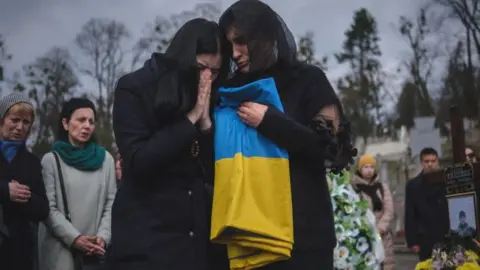
Ukraine has been defending itself against Russia's full-scale invasion for two years
The former commander of the UK's Joint Forces Command has warned that Ukraine could face defeat by Russia in 2024.
General Sir Richard Barrons has told the BBC there is "a serious risk" of Ukraine losing the war this year.
The reason, he says, is "because Ukraine may come to feel it can't win".
"And when it gets to that point, why will people want to fight and die any longer, just to defend the indefensible?"
Ukraine is not yet at that point.
But its forces are running critically low on ammunition, troops and air defences. Its much-heralded counter-offensive last year failed to dislodge the Russians from ground they had seized and now Moscow is gearing up for a summer offensive.
So what will that look like and what are its likely strategic objectives?
"The shape of the Russian offensive that's going to come is pretty clear," says Gen Barrons.
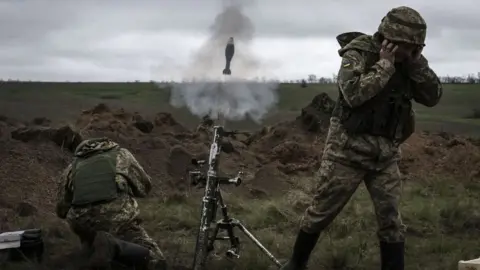
"We are seeing Russia batter away at the front line, employing a five-to-one advantage in artillery, ammunition, and a surplus of people reinforced by the use of newish weapons."
Getty Images
Ukraine is now desperately short of ammunition, in part because of political wrangling in Western nations
These include the FAB glide bomb, an adapted Soviet-era "dumb bomb" fitted with fins, GPS guidance and 1500kg of high explosive, that is wreaking havoc on Ukrainian defences.
"At some point this summer," says Gen Barrons, "we expect to see a major Russian offensive, with the intent of doing more than smash forward with small gains to perhaps try and break through the Ukrainian lines.
"And if that happens we would run the risk of Russian forces breaking through and then exploiting into areas of Ukraine where the Ukrainian armed forces cannot stop them."
But where?
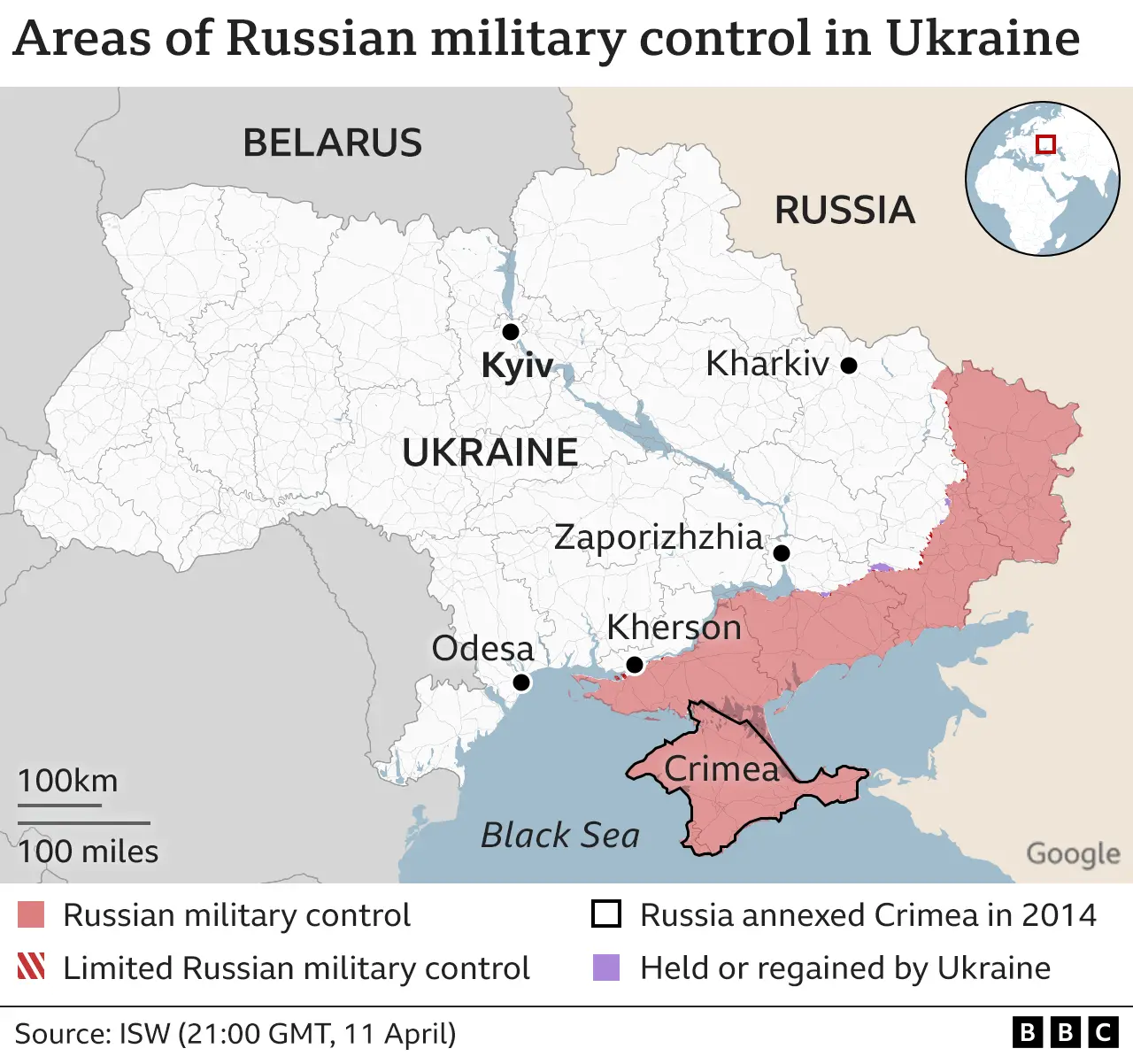
Last year the Russians knew exactly where Ukraine was likely to attack - from the direction of Zaporizhzhia south towards the Sea of Azov. They planned accordingly and successfully blunted Ukraine's advance.
Now the boot is on the other foot as Russia masses its troops and keeps Kyiv guessing where it is going to attack next.

"One of the challenges the Ukrainians have," says Dr Jack Watling, senior research fellow in land warfare at the Whitehall thinktank the Royal United Services Institute (Rusi), "is that the Russians can choose where they commit their forces.
"It's a very long front line and the Ukrainians need to be able to defend all of it."
Which, of course, they cannot.
"The Ukrainian military will lose ground," says Dr Watling. "The question is: how much and which population centres are going to be affected?"
It is quite possible that Russia's General Staff have yet to go firm on which direction to designate as their main effort. But it is possible to broadly break down their various options into three broad locations.
Kharkiv
"Kharkiv," says Dr Watling, "is certainly vulnerable."
As Ukraine's second city, situated perilously close to the Russian border, Kharkiv is a tempting goal for Moscow.
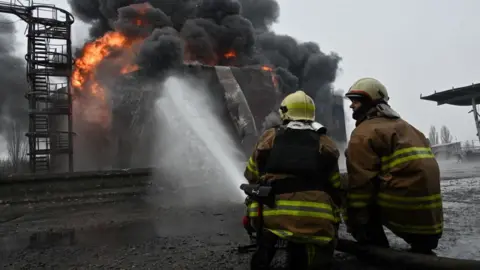
It is currently being pummelled daily with Russian missile strikes, with Ukraine unable to field sufficient air defences to ward off the lethal mix of drones, cruise and ballistic missiles aimed in its direction.
Getty Images
Russia hits Kharkiv daily with drones, missiles and shelling
"I think the offensive this year will have breaking out of the Donbas as its first objective," adds Gen Barrons, "and their eye will be on Kharkiv which is 29km [18 miles] or so from the Russian border, a major prize."
Could Ukraine still function as a viable entity if Kharkiv were to fall? Yes, say analysts, but it would be a catastrophic blow to both its morale and its economy.
The Donbas
The area of eastern Ukraine known collectively as the Donbas has been at war since 2014, when Moscow-backed separatists declared themselves "people's republics".
In 2022 Russia illegally annexed the two Donbas oblasts, or provinces, of Donetsk and Luhansk. This is where most of the fighting on land has been taking place over the past 18 months.
Ukraine has, controversially, expended enormous efforts, in both manpower and resources, in trying to hold on to first the town of Bakhmut, and then Avdiivka.
It has lost both, as well as some of its best fighting troops, in the attempt.
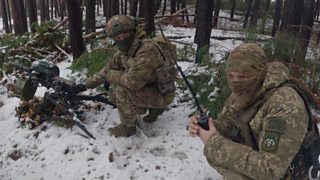
Contains some upsetting scenes.
BBC documentary shows Ukrainian front line troops defending against a Russian attack
Kyiv has countered that its resistance has inflicted disproportionately high casualties on the Russians.
That is true, with the battlefield in these places being dubbed "the meat grinder".
But Moscow has plenty more troops to throw into the fight - and Ukraine does not.
The Commander of US Forces in Europe, General Christopher Cavoli, has warned that unless the US rushes significantly more weapons and ammunition to Ukraine then its forces will be outgunned on the battlefield by ten to one.
Mass matters. The Russian army's tactics, leadership and equipment may be inferior to Ukraine's, but it has such superiority in numbers, especially artillery, that if it does nothing else this year, its default option will be to keep pushing Ukraine's forces back in a westward direction, taking village after village.
Zaporizhzhia
This, too, is a tempting prize for Moscow.
The southern Ukrainian city of more than 700,000 (in peacetime) sits dangerously close to the Russian front lines.
It is also something of a thorn in Russia's side given that it is the capital of an oblast of the same name that Russia has illegally annexed, and yet the city is still living freely in Ukrainian hands.
But the formidable defences that Russia built south of Zaporizhzhia last year, in the correct expectation of a Ukrainian attack, would now complicate a Russian advance from there.
The so-called Surovikin Line, consisting of triple layers of defences, is laced with the largest, most densely packed minefield in the world. Russia could partially dismantle this but its preparations would probably be detected.
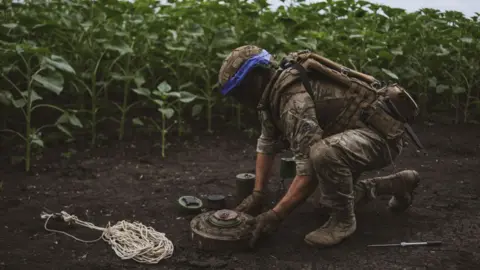
Getty Images
Ukraine is now one of the most heavily mined places in the world
Russia's strategic objective this year may not even be territorial. It could simply be to crush Ukraine's fighting spirit and convince its Western backers that this war is a lost cause.
Dr Jack Watling believes the Russian objective is "to try to generate a sense of hopelessness".
"This [Russian] offensive will not decisively end the conflict, irrespective of how it goes for either side," he says.
President Vladimir Putin has warned that Russia would be “at war” with the United States and its allies if they lift restrictions on Ukraine's use of long-range Western weapons.
Putin's vow to follow such a move with “appropriate decisions” was his latest, perhaps most drastic attempt to draw red lines over NATO members' backing for Kyiv, and it came on the eve of a meeting in Washington where the issue is expected to be high on the agenda.
British Prime Minister Keir Starmer held talks with President Joe Biden at the White House on Friday afternoon, as London clashed with Moscow over the expulsion of six diplomats accused of spying — accusations the U.K. dismissed as "baseless."
Before beginning the talks, Biden said the U.S. is "committed" to standing with the U.K. to help support Ukraine against Russia.
"I’ve often said there’s no issue of global consequence where the United States and U.K. can’t work together," Biden said. "It’s clear that Putin will not prevail in this war. The people of Ukraine will prevail."
Asked about Putin’s comments on a potential direct war with Russia, Biden told reporters, "I don’t think much about Vladimir Putin."
A White House readout of the meeting said that the two leaders "reaffirmed their unwavering support for Ukraine as it continues to defend against Russia’s aggression," and that they shared "deep concern about Iran and North Korea’s provision of lethal weapons to Russia."
The U.S. and its allies have appeared increasingly open to letting Ukraine use long-range Western missiles to strike deep inside Russia, the culmination of a monthslong push by Kyiv that has sparked the Kremlin's fury.
“We are not talking about allowing or not allowing the Ukrainian regime to strike Russia with these weapons,” Putin said Thursday in comments to propagandist Pavel Zarubin. “We are talking about deciding whether NATO countries are directly involved in the military conflict or not.”
 Starmer, right, is in Washington for talks alongside his top diplomat David Lammy. Stefan Rousseau / WPA Pool via Getty Images
"This will mean that NATO countries, the U.S. and European countries are at war with Russia," Putin said. "And if this is so, then, bearing in mind the change in the very essence of this conflict, we will make appropriate decisions based on the threats that will be created for us."
Putin added that the Ukrainian army does not have the ability to program long-range missiles or the satellite data necessary for their targeting, relying on NATO military personnel for those tasks.
Putin’s comments were echoed by the speaker of Russia’s State Duma, Vyacheslav Volodin, in a Telegram post Friday. “NATO became a participant in military operations in Ukraine,” Volodin wrote. “They are waging war on our country.”
Kremlin spokesman Dmitry Peskov also told reporters Friday that Putin's message was “extremely clear, unambiguous and does not allow for any double readings.”
“We have no doubt that it has reached its intended recipients,” Peskov noted.
The Kremlin and Russian propaganda have been portraying the war in Ukraine as a clash with the West and NATO since the beginning of the full-scale invasion in February 2022, and the latest threatening rhetoric from Putin appears to be an escalation of that strategy at a crucial moment.
It was unclear what Moscow's implied response might be, though in June Putin suggested he could provide arms to other countries to hit Western targets.
Putin has repeatedly warned the West not to cross Moscow’s so-called red lines, which he warned could trigger nuclear conflict, but they have been repeatedly crossed without such a response from the Kremlin.
Ukrainian forces launched the first invasion of Russian territory since World War II last month, only to be met with a relatively muted response.
After more than a month, the Kremlin announced Thursday it had begun a major counteroffensive to retake some of the land seized in the Kursk border region, while its forces press on with an offensive in Ukraine's east that threatens the key strategic hub city of Pokrovsk.
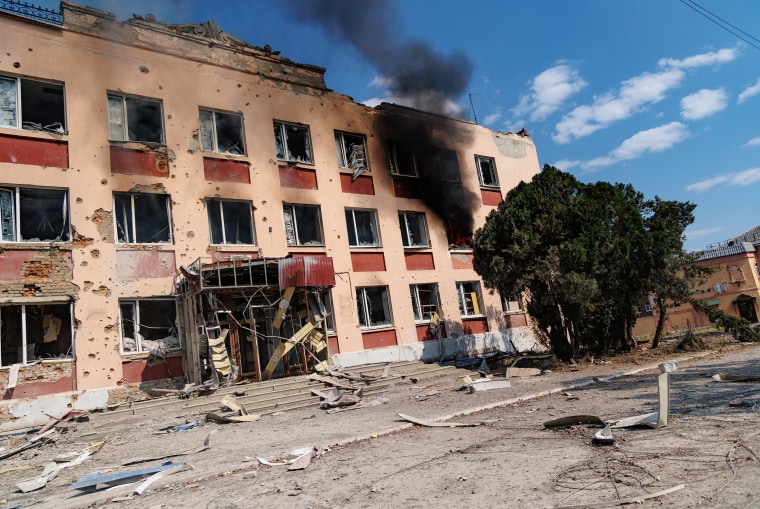 A destroyed building in Sudzha, a border town seized in Ukraine's daring incursion.Oleg Palchyk / Global Images Ukraine via Getty ImagesAs things stand, Kyiv only has permission to use Western-supplied long-range weapons such as American ATACMS and British Storm Shadows to strike Russian territory along its border, and only in response to attacks from these areas.
It’s been pleading for that policy to change so it can strike military assets deeper inside Russia that are used to launch attacks on Ukrainian cities.
A destroyed building in Sudzha, a border town seized in Ukraine's daring incursion.Oleg Palchyk / Global Images Ukraine via Getty Images
But Washington and its allies have been reluctant to allow that, fearing a major escalation.
That appears to have shifted in recent weeks.
Secretary of State Antony Blinken was in Kyiv on Wednesday with his British counterpart, and Biden indicated earlier this week that the U.S. was “working out” the issue.
Members of the bipartisan Congressional Ukraine Caucus signed a letter earlier this week urging Biden to lift restrictions on Kyiv's use of long-range weapons, saying they are “inconsistent” with what America would ever accept for its own operations or restrictions that the U.S. places on its other allies, such as Israel.
Ahead of his meeting with Biden, the British leader's office told NBC News that Starmer told reporters the U.K. does not seek any conflict with Russia. But he noted: “Russia started this conflict. Russia illegally invaded Ukraine. Russia could end this conflict straight away.”
As he arrived in Washington, Russia’s FSB internal security service announced it had revoked the accreditation of six British diplomats in Moscow whose actions it said had signs of “reconnaissance and subversive work.”
.
Ukraine's counter-offensive has resulted in further advances and some "extremely fierce battles", a minister in Kyiv says
Russia has argued the manoeuvre is failing, but the head of the Nato military alliance reckons it's still "early days" for Ukraine's military push
The Ukrainians say their troops have recaptured seven settlements and at least 90 sq km (35 square miles) since launching the offensive
Earlier, at least three people were killed in a relatively rare Russian attack on the Black Sea port of Odesa - and three others died after strikes in the eastern Donetsk region
And the Kremlin says it's concerned after unconfirmed reports of an injury for a senior Chechen commander who's had a prominent role during the invasion
Live Reporting
Related Stories
Live Reporting
The day started with news of an attack on Odesa, before our focus returned to Ukraine's ongoing counter-offensive. As the Nato chief put it a short time ago, it's "early days".Make sure your next destination is our report on the mystery surrounding a top Chechen commander fighting for Russia
And look back on the relatively rare attack on Odesa by heading here
Thanks for following along with us today - you've been reading the words of Nicholas Yong, Ece Goksedef, Dulcie Lee, Emma Owen and me. Until next time.
Ukraine war: Latest updates
Ukrainian servicemen check a destroyed Russian vehicle near the recaptured village of StorozheveImage caption: Ukrainian servicemen check a destroyed Russian vehicle near the recaptured village of Storozheve
Here's a summary of the latest developments from Ukraine:A minister in Kyiv has reported "extremely fierce battles" in the country's counter-offensive
Hanna Maliar said soldiers advanced by distances of 200m to 500m towards Bakhmut, and 300m to 500m in the direction of Zaporizhzhia. We're not able to verify this independently
Nato chief Jens Stoltenberg observed that the military manoeuvre was still in its "early days"
Mystery surrounds the health of a top Chechen commander who's been active for Russia in Ukraine. The Kremlin says it's concerned after a report that Adam Delimkhanov was woundedAt least three people have been killed and several others injured in a relatively rare alleged Russian attack on Odesa, and three more civilians were killed overnight in the eastern Donetsk region
Belarusian leader Alexander Lukashenko said his country would enter the war if it was shown aggression. He earlier said Belarus had started taking delivery of Russian tactical nuclear weapons
UN nuclear watchdog chief Rafael Grossi's visit to the Zaporizhzhia nuclear power plant was delayed - he's due to inspect water levels after a major dam breach nearby last week
Russia plans to contract criminals to serve in war
Russia is preparing to allow suspected or convicted criminals to fight in neighbouring Ukraine.
The lower house of parliament, the State Duma, today voted to give its initial backing to legislation that would let the defence ministry to sign contracts with a limited number of criminals.
Those who do sign up would be exempt from criminal liability upon completion of their contract.
Moscow's forces have suffered heavy losses since the start of the war and the Wagner mercenary group was previously allowed to recruit convicts. Now the defence ministry looks set to follow a similar plan.
Russians came to Ukraine to 'destroy everything' - Ukraine official
Ukrianians now understand that Russia is "not just the enemy, but people who came to Ukrainian lands to destroy everything", a Ukrainian government official says.
Speaking to the BBC about the country's counter-offensive, Serhiy Leshchenko, adviser to the president's chief of staff, admits that it is "not easy to go".
While Ukraine has made some progress in the Donbas region, Russia is a "strong enemy" with "a lot of ammunition", he says. This has escalated the situation on other frontlines, Leshchenko adds.
Leshchenko also labels a claim from Russian President Vladimir Putin - that he started the war to defend the people of Donbas - as the "biggest fake of 21st century".
Still early days in Ukrainian counter-offensive, says Nato chief
Stoltenberg held a press conference ahead of a meeting of Nato defence ministers in BrusselsImage caption: Stoltenberg held a press conference ahead of a meeting of Nato defence ministers in Brussels
The Nato chief says it's still "early days" in Ukraine's counter-offensive.
"We do not know if this will be a turning point in the war," Jens Stoltenberg told reporters in Brussels. "The more gains Ukraine makes, the stronger their hand will be at the negotiating table."
He also said the next Nato summit - which will be held in Vilnius in early July - "will make clear that Ukraine's future is in Nato".
Kyiv has been eager to join the military alliance of Western nations - something Russia vehemently opposes.
Article share tools
Satellite images show fallen water levels near nuclear plant
We told you earlier that a visit to the Zaporizhzhia nuclear power plant by the head of the UN's nuclear watchdog appeared to have been delayed. Rafael Grossi was planning to check nearby water levels after a major dam breach on 6 June caused levels in a reservoir to fall.
It's worth explaining that the power plant has shut down four reactors since last September, amid fighting - after Russian troops occupied the area including the power plant itself.
The power plant needs a certain level of water to keep the reactors in cool shutdown - in other words to reduce the residual heat from the shutdown reactors, to cool the spent fuel, and to cool the emergency diesel generators if the plant loses off-site power.
Satellite images from before and after the incident showed how sharply water levels have dropped in the Dnipro river.
Copernicus Sentinel-2/ReutersThe water level near the Zaporizhzhia nuclear power plant on 5 JuneImage caption: The water level near the Zaporizhzhia nuclear power plant on 5 June
Copernicus Sentinel-2/ReutersCopyright: Copernicus Sentinel-2/ReutersA similar view yesterdayImage caption:
Reports that a top Chechen paramilitary commander has been injured are of "great concern", the Kremlin says.
Responding to questions about the health of Adam Delimkhanov, Russian presidential spokesman Dmitry Peskov urged reporters to wait for "real truthful information".
Earlier, a post from Zvezda TV - which is run by Russia's defence ministry - said Delimkhanov sustained injuries but was alive.
The circumstances remain unclear, and the BBC has been unable to verify the report.
Ukraine considers Delimkhanov to be the head of Chechen volunteer units fighting in Ukraine, and a close ally of Chechen leader Ramzan Kadyrov.
Adam Delimkhanov's current status is unknown
The man behind Ukraine's counter-offensive
Ukrainian armyGen Zaluzhny never served in the Soviet Army and has steered clear of Soviet-style military hierarchyImage caption: Gen Zaluzhny never served in the Soviet Army and has steered clear of Soviet-style military hierarchy
Ukraine's long-awaited attempt to take back the territories in the east and south of the country, occupied by Russia for the past 18 months, is now in full swing.
A key figure in planning and executing this operation is Gen Valery Zaluzhny, Ukraine's 49-year-old commander-in-chief. Little known until recently, his popularity now rivals that of President Volodymyr Zelensky.
Gen Zaluzhny, or "our Valera" as friends and old classmates like to call him, was appointed commander-in-chief of the Ukrainian military in July 2021.
Those who know him well say the appointment, pushed through personally by President Zelensky, came as a surprise to the general and many others too as his promotion involved climbing several steps on the career ladder.
Church icons cleaned after Odesa strikes
As we've been reporting, relatively rare missile strikes in Odesa killed at least three people overnight.
Locals in the Black Sea port city have started the clean-up. Take a look at the following pictures showing damage in a church.
Smashed glass and broken windows can be seen inside the churchImage caption: Smashed glass and broken windows can be seen inside the church
ShutterstockReligious icons were removed from the church to be cleaned by localsImage caption: Religious icons were removed from the church to be cleaned by locals
Another woman cleans a religious icon from the damaged churchImage caption: Another woman cleans a religious icon from the damaged church
What's happened today so far
ReutersCopyright: ReutersA police officer stands next to a shopping mall damaged by a Russian missile strike in OdesaImage caption: A police officer stands next to a shopping mall damaged by a Russian missile strike in Odesa
Here is the latest on the war in Ukraine:Ukraine's counter-offensive has led to some advances and "extremely fierce battles", a minister in Kyiv has said
Hanna Maliar said soldiers advanced by 200m to 500m towards Bakhmut, and 300m to 500m in the direction of Zaporizhzhia. We're not able to verify this independently
The International Atomic Energy Agency (IAEA) chief Rafael Grossi's visit to the Zaporizhzhia nuclear power plant today has been delayed - he was due to inspect water levels after the Kakhovka dam breach
Three civilians have been killed in Donetsk and three others killed in Odesa where multi-storey buildings collapsed in Russia's attacks overnight. The search under the rubble in Odesa continues
There is a uncertainty over the state of Chechen commander Adam Delimkhanov - Russian military TV says he's wounded and Chechen leader Ramzan Kadyrov said he couldn't contact his "dear brother", asking for help to find him
Belarus would enter war if we were shown aggression - Lukashenko
Belarusian leader Alexander Lukashenko says Belarus would enter the conflict in Ukraine if there was aggression against the country, Russian state-owned news agency Tass reports.
He also says that his country has started taking delivery of Russian tactical nuclear weapons - shorter-range, less powerful nuclear weapons that could potentially be used on the battlefield.
A close ally of Russian President Vladimir Putin, Lukashenko claimed that some of the weapons are three times more powerful than the atomic bombs dropped on Hiroshima and Nagasaki in the Second World War in 1945.
Alexander Lukashenko is a close ally of Vladimir Putin
Lukashenko, who has allowed Russian forces to use his country as a base in the invasion of Ukraine, has said the nuclear deployment would act as a deterrent against potential aggressors.
The deployment is Moscow's first move of such warheads outside Russia since the fall of the Soviet Union in 1991.
Counter-offensive brings 'extremely fierce battles'
A Ukrainian soldier near the recently recaptured settlement of NeskuchneImage caption: A Ukrainian soldier near the recently recaptured settlement of Neskuchne
An update now from Ukraine's deputy defence minister, who's given a further picture of her troops' latest advances.
Hanna Maliar has posted to say that soldiers have advanced by distances of 200m to 500m in the direction of Bakhmut.
And they've moved forwards by 300m to 500m in the direction of Zaporizhzhia, she adds. "Extremely fierce battles" have unfolded, she says.
You may recall that Bakhmut was the site of the longest, bloodiest battle of the war so far.Ukrainians remember Bakhmut, city of salt and sparkling wine
That report of an injury to a Chechen commander comes after yesterday's claim that a top Russian officer had been killed in Ukraine.
The apparent death of Maj Gen Sergei Goryachev was reported on Tuesday by pro-Kremlin military blogger Yuri Kotenok.
A Russian-installed official in an occupied area of Ukraine later acknowledged the report, offering his condolences. "The army has lost one of its brightest and most effective military commanders, who combined the highest professionalism with personal courage," wrote Vladimir Rogov.
The Kremlin is yet to confirm Goryachev's death, and the BBC has not verified the report itself. However, Russian military bloggers have proven an insightful source of information during the war. Notably, President Vladimir Putin met a group of them yesterday.
Chechen commander wounded - Adam Delimkhanov commanding Chechen forces in Mariupol in Ukraine last yearImage caption: Adam Delimkhanov commanding Chechen forces in Mariupol in Ukraine last year
One of the top commanders of the Chechen paramilitary group fighting in Ukraine has been injured, according to Russian military TV.
Adam Delimkhanov was wounded but still alive, according to a post from Zvezda TV - which is run by Russia's defence ministry. It cited information from the press office of the Duma (Russia's lower house of parliament), of which Delimkhanov is also a member.
The circumstances remain unclear, and the BBC has been unable to verify the report. Zvezda later quoted the Duma speaker as saying that Delimkhanov was "alive and well".
Ukraine considers Delimkhanov to be the head of Chechen volunteer units fighting in Ukraine, and a close ally of Chechen leader Ramzan Kadyrov. Kadyrov himself wrote that he could not contact Delimkhanov, and asked for help finding his "dear brother".
On Monday, the Russian defence ministry signed a contract with the Chechen paramilitary unit to bring it under direct control.
Ukraine's general prosecutor's office
Ukraine has accused Russia of attacking a vehicle near the two countries' shared border, and killing six people.
Ukraine's general prosecutor's office writes on Telegram that the attack happened yesterday, in the north-eastern Sumy region. It says the victims were two civilians and four forestry workers.
The office says an investigation has been launched. The BBC hasn't been able to independently verify the claims, and Russia hasn't commented.
Tanks, food prices and the latest on the dam devastation
EPAVolunteers deliver humanitarian aid to local residents in the village of Afanasiivka following the dam breachImage caption: Volunteers deliver humanitarian aid to local residents in the village of Afanasiivka following the dam breach
We've been focusing on the overnight attacks so far today, but don't want to lose sight of the bigger picture. Earlier we told you about President Putin's latest comments, and in case you missed them, here are a few of yesterday's other developments:Russia shared footage - believed by the BBC to be genuine - showing its troops have captured multiple Western-made military vehicles
A prominent Russian military blogger said a high-ranking Russian commander had been killed in Ukraine - although official sources are yet to confirm this
Ukrainian officials warned of price increases of staple products such as soy beans, corn and wheat will likely increase as a result of flooding from the Kakhovka dam breach last week
Traces of cholera and E. coli were detected in the floodwaters of the River Dnipro after the dam breach – but no outbreak of infectious diseases has been recorded so far
Ukrainian armed forces/A warehouse was among the buildings hitImage caption: A warehouse was among the buildings hit
Odesa was a prize target for Russian forces from the start of this war and it has come under periodic and deadly attack. This latest bombardment is clearly in response to Ukraine's military offensive further east - proving that Russia still has the ability to hit Ukraine's biggest cities.
Until now, much of Russia's bombardment of Odesa has targeted its strategic port, which is vital to Ukraine's grain exports through the Black Sea.
Residential areas have been hit, too - but the centre of this historic, cosmopolitan city has largely escaped some of the worst of the damage. Two art museums were hit last year but the opera and ballet theatre continues to run and has a full summer programme.
Among the buildings hit overnight were a McDonald's restaurant and shops in the city centre - as well as a residential complex and a shopping chain's warehouse. As with the previous night's deadly attack on Kryvyih Rih, this is Russia showing it can still bomb where and when it chooses.
Posted at 1:58 14 Jun 20231:58 The facts so far
Here's what we know so far about the overnight Russian attack on the Black Sea port of Odesa:
At least three people have reportedly been killed and another 13 injured
Ukraine says it came under fire from 10 missiles and 10 drones overnight, most of which were shot down. Three civilians were also killed in the Donetsk region
Among the buildings hit in Odesa were a warehouse, restaurants and shops
The strategic port is vital to Ukraine's grain exports through the Black Sea, but it has come under fire relatively infrequently during the war
The strikes come as Ukraine's counter-offensive continues, with officials claiming around a square mile (3 sq km) of territory have been gained in the past three days
Russia is yet to comment on the latest alleged attack.
Posted at 1:43 14 Jun 20231:43 14 Jun 2023
UN official 'waiting until it's safe' to visit nuclear plant
ReutersCopyright: ReutersThe Zaporizhzhia nuclear power plant pictured from the banks of the Kakhovka reservoir last weekImage caption: The Zaporizhzhia nuclear power plant pictured from the banks of the Kakhovka reservoir last week
The Ukrainian side appears to have confirmed that a visit by the UN's nuclear chief Rafael Grossi to check on the Zaporizhzhia nuclear power plant has been delayed (see our earlier update).
A senior government official told the Reuters news agency: "He's waiting to be able to travel safely". The official, who spoke on condition of anonymity, didn't say when Grossi would travel. Russian news agencies say the visit has been postponed by a day.
Grossi, the head of the International Atomic Energy Agency (IAEA), held talks with Ukrainian President Volodymyr Zelenskiy in Kyiv on Tuesday.
The IAEA wants access to a site near the plant to check water levels, amid concerns caused by major flooding following last week's Kakhovka dam breach.
Posted at 1:29 14 Jun 20231:29 14 Jun 2023
Ukraine made limited territorial gains yesterday, researchers say
The Institute for the Study of War is a US-based group that provides daily updates on the war in Ukraine.
It reports on changes to the front lines using a mixture of sources, including military intelligence and footage published online.
Its latest update says that Ukraine made "limited territorial gains" yesterday.
As our last post says, the Ukrainians claim to have taken back a square mile over the past three days.
Russia has argued the manoeuvre is failing, but the head of the Nato military alliance reckons it's still "early days" for Ukraine's military push
The Ukrainians say their troops have recaptured seven settlements and at least 90 sq km (35 square miles) since launching the offensive
Earlier, at least three people were killed in a relatively rare Russian attack on the Black Sea port of Odesa - and three others died after strikes in the eastern Donetsk region
And the Kremlin says it's concerned after unconfirmed reports of an injury for a senior Chechen commander who's had a prominent role during the invasion
Live Reporting
Related Stories
Live Reporting
Mystery surrounds the health of top Chechen commander Adam Delimkhanov (pictured in 2020)Image caption: Mystery surrounds the health of top Chechen commander Adam Delimkhanov (pictured in 2020)
And it's with that quick recap of some of today's key events that we'll close this live coverage.The day started with news of an attack on Odesa, before our focus returned to Ukraine's ongoing counter-offensive. As the Nato chief put it a short time ago, it's "early days".Make sure your next destination is our report on the mystery surrounding a top Chechen commander fighting for Russia
And look back on the relatively rare attack on Odesa by heading here
Thanks for following along with us today - you've been reading the words of Nicholas Yong, Ece Goksedef, Dulcie Lee, Emma Owen and me. Until next time.
Ukraine war: Latest updates
Ukrainian servicemen check a destroyed Russian vehicle near the recaptured village of StorozheveImage caption: Ukrainian servicemen check a destroyed Russian vehicle near the recaptured village of Storozheve
Here's a summary of the latest developments from Ukraine:A minister in Kyiv has reported "extremely fierce battles" in the country's counter-offensive
Hanna Maliar said soldiers advanced by distances of 200m to 500m towards Bakhmut, and 300m to 500m in the direction of Zaporizhzhia. We're not able to verify this independently
Nato chief Jens Stoltenberg observed that the military manoeuvre was still in its "early days"
Mystery surrounds the health of a top Chechen commander who's been active for Russia in Ukraine. The Kremlin says it's concerned after a report that Adam Delimkhanov was woundedAt least three people have been killed and several others injured in a relatively rare alleged Russian attack on Odesa, and three more civilians were killed overnight in the eastern Donetsk region
Belarusian leader Alexander Lukashenko said his country would enter the war if it was shown aggression. He earlier said Belarus had started taking delivery of Russian tactical nuclear weapons
UN nuclear watchdog chief Rafael Grossi's visit to the Zaporizhzhia nuclear power plant was delayed - he's due to inspect water levels after a major dam breach nearby last week
Russia plans to contract criminals to serve in war
Russia is preparing to allow suspected or convicted criminals to fight in neighbouring Ukraine.
The lower house of parliament, the State Duma, today voted to give its initial backing to legislation that would let the defence ministry to sign contracts with a limited number of criminals.
Those who do sign up would be exempt from criminal liability upon completion of their contract.
Moscow's forces have suffered heavy losses since the start of the war and the Wagner mercenary group was previously allowed to recruit convicts. Now the defence ministry looks set to follow a similar plan.
Russians came to Ukraine to 'destroy everything' - Ukraine official
Ukrianians now understand that Russia is "not just the enemy, but people who came to Ukrainian lands to destroy everything", a Ukrainian government official says.
Speaking to the BBC about the country's counter-offensive, Serhiy Leshchenko, adviser to the president's chief of staff, admits that it is "not easy to go".
While Ukraine has made some progress in the Donbas region, Russia is a "strong enemy" with "a lot of ammunition", he says. This has escalated the situation on other frontlines, Leshchenko adds.
Leshchenko also labels a claim from Russian President Vladimir Putin - that he started the war to defend the people of Donbas - as the "biggest fake of 21st century".
Still early days in Ukrainian counter-offensive, says Nato chief
Stoltenberg held a press conference ahead of a meeting of Nato defence ministers in BrusselsImage caption: Stoltenberg held a press conference ahead of a meeting of Nato defence ministers in Brussels
The Nato chief says it's still "early days" in Ukraine's counter-offensive.
"We do not know if this will be a turning point in the war," Jens Stoltenberg told reporters in Brussels. "The more gains Ukraine makes, the stronger their hand will be at the negotiating table."
He also said the next Nato summit - which will be held in Vilnius in early July - "will make clear that Ukraine's future is in Nato".
Kyiv has been eager to join the military alliance of Western nations - something Russia vehemently opposes.
Article share tools
Satellite images show fallen water levels near nuclear plant
We told you earlier that a visit to the Zaporizhzhia nuclear power plant by the head of the UN's nuclear watchdog appeared to have been delayed. Rafael Grossi was planning to check nearby water levels after a major dam breach on 6 June caused levels in a reservoir to fall.
It's worth explaining that the power plant has shut down four reactors since last September, amid fighting - after Russian troops occupied the area including the power plant itself.
The power plant needs a certain level of water to keep the reactors in cool shutdown - in other words to reduce the residual heat from the shutdown reactors, to cool the spent fuel, and to cool the emergency diesel generators if the plant loses off-site power.
Satellite images from before and after the incident showed how sharply water levels have dropped in the Dnipro river.
Copernicus Sentinel-2/ReutersThe water level near the Zaporizhzhia nuclear power plant on 5 JuneImage caption: The water level near the Zaporizhzhia nuclear power plant on 5 June
Copernicus Sentinel-2/ReutersCopyright: Copernicus Sentinel-2/ReutersA similar view yesterdayImage caption:
Reports that a top Chechen paramilitary commander has been injured are of "great concern", the Kremlin says.
Responding to questions about the health of Adam Delimkhanov, Russian presidential spokesman Dmitry Peskov urged reporters to wait for "real truthful information".
Earlier, a post from Zvezda TV - which is run by Russia's defence ministry - said Delimkhanov sustained injuries but was alive.
The circumstances remain unclear, and the BBC has been unable to verify the report.
Ukraine considers Delimkhanov to be the head of Chechen volunteer units fighting in Ukraine, and a close ally of Chechen leader Ramzan Kadyrov.
Adam Delimkhanov's current status is unknown
The man behind Ukraine's counter-offensive
Ukrainian armyGen Zaluzhny never served in the Soviet Army and has steered clear of Soviet-style military hierarchyImage caption: Gen Zaluzhny never served in the Soviet Army and has steered clear of Soviet-style military hierarchy
Ukraine's long-awaited attempt to take back the territories in the east and south of the country, occupied by Russia for the past 18 months, is now in full swing.
A key figure in planning and executing this operation is Gen Valery Zaluzhny, Ukraine's 49-year-old commander-in-chief. Little known until recently, his popularity now rivals that of President Volodymyr Zelensky.
Gen Zaluzhny, or "our Valera" as friends and old classmates like to call him, was appointed commander-in-chief of the Ukrainian military in July 2021.
Those who know him well say the appointment, pushed through personally by President Zelensky, came as a surprise to the general and many others too as his promotion involved climbing several steps on the career ladder.
Church icons cleaned after Odesa strikes
As we've been reporting, relatively rare missile strikes in Odesa killed at least three people overnight.
Locals in the Black Sea port city have started the clean-up. Take a look at the following pictures showing damage in a church.
Smashed glass and broken windows can be seen inside the churchImage caption: Smashed glass and broken windows can be seen inside the church
ShutterstockReligious icons were removed from the church to be cleaned by localsImage caption: Religious icons were removed from the church to be cleaned by locals
Another woman cleans a religious icon from the damaged churchImage caption: Another woman cleans a religious icon from the damaged church
What's happened today so far
ReutersCopyright: ReutersA police officer stands next to a shopping mall damaged by a Russian missile strike in OdesaImage caption: A police officer stands next to a shopping mall damaged by a Russian missile strike in Odesa
Here is the latest on the war in Ukraine:Ukraine's counter-offensive has led to some advances and "extremely fierce battles", a minister in Kyiv has said
Hanna Maliar said soldiers advanced by 200m to 500m towards Bakhmut, and 300m to 500m in the direction of Zaporizhzhia. We're not able to verify this independently
The International Atomic Energy Agency (IAEA) chief Rafael Grossi's visit to the Zaporizhzhia nuclear power plant today has been delayed - he was due to inspect water levels after the Kakhovka dam breach
Three civilians have been killed in Donetsk and three others killed in Odesa where multi-storey buildings collapsed in Russia's attacks overnight. The search under the rubble in Odesa continues
There is a uncertainty over the state of Chechen commander Adam Delimkhanov - Russian military TV says he's wounded and Chechen leader Ramzan Kadyrov said he couldn't contact his "dear brother", asking for help to find him
Belarus would enter war if we were shown aggression - Lukashenko
Belarusian leader Alexander Lukashenko says Belarus would enter the conflict in Ukraine if there was aggression against the country, Russian state-owned news agency Tass reports.
He also says that his country has started taking delivery of Russian tactical nuclear weapons - shorter-range, less powerful nuclear weapons that could potentially be used on the battlefield.
A close ally of Russian President Vladimir Putin, Lukashenko claimed that some of the weapons are three times more powerful than the atomic bombs dropped on Hiroshima and Nagasaki in the Second World War in 1945.
Alexander Lukashenko is a close ally of Vladimir Putin
Lukashenko, who has allowed Russian forces to use his country as a base in the invasion of Ukraine, has said the nuclear deployment would act as a deterrent against potential aggressors.
The deployment is Moscow's first move of such warheads outside Russia since the fall of the Soviet Union in 1991.
Counter-offensive brings 'extremely fierce battles'
A Ukrainian soldier near the recently recaptured settlement of NeskuchneImage caption: A Ukrainian soldier near the recently recaptured settlement of Neskuchne
An update now from Ukraine's deputy defence minister, who's given a further picture of her troops' latest advances.
Hanna Maliar has posted to say that soldiers have advanced by distances of 200m to 500m in the direction of Bakhmut.
And they've moved forwards by 300m to 500m in the direction of Zaporizhzhia, she adds. "Extremely fierce battles" have unfolded, she says.
You may recall that Bakhmut was the site of the longest, bloodiest battle of the war so far.Ukrainians remember Bakhmut, city of salt and sparkling wine
That report of an injury to a Chechen commander comes after yesterday's claim that a top Russian officer had been killed in Ukraine.
The apparent death of Maj Gen Sergei Goryachev was reported on Tuesday by pro-Kremlin military blogger Yuri Kotenok.
A Russian-installed official in an occupied area of Ukraine later acknowledged the report, offering his condolences. "The army has lost one of its brightest and most effective military commanders, who combined the highest professionalism with personal courage," wrote Vladimir Rogov.
The Kremlin is yet to confirm Goryachev's death, and the BBC has not verified the report itself. However, Russian military bloggers have proven an insightful source of information during the war. Notably, President Vladimir Putin met a group of them yesterday.
Chechen commander wounded - Adam Delimkhanov commanding Chechen forces in Mariupol in Ukraine last yearImage caption: Adam Delimkhanov commanding Chechen forces in Mariupol in Ukraine last year
One of the top commanders of the Chechen paramilitary group fighting in Ukraine has been injured, according to Russian military TV.
Adam Delimkhanov was wounded but still alive, according to a post from Zvezda TV - which is run by Russia's defence ministry. It cited information from the press office of the Duma (Russia's lower house of parliament), of which Delimkhanov is also a member.
The circumstances remain unclear, and the BBC has been unable to verify the report. Zvezda later quoted the Duma speaker as saying that Delimkhanov was "alive and well".
Ukraine considers Delimkhanov to be the head of Chechen volunteer units fighting in Ukraine, and a close ally of Chechen leader Ramzan Kadyrov. Kadyrov himself wrote that he could not contact Delimkhanov, and asked for help finding his "dear brother".
On Monday, the Russian defence ministry signed a contract with the Chechen paramilitary unit to bring it under direct control.
Ukraine's general prosecutor's office
Ukraine has accused Russia of attacking a vehicle near the two countries' shared border, and killing six people.
Ukraine's general prosecutor's office writes on Telegram that the attack happened yesterday, in the north-eastern Sumy region. It says the victims were two civilians and four forestry workers.
The office says an investigation has been launched. The BBC hasn't been able to independently verify the claims, and Russia hasn't commented.
Tanks, food prices and the latest on the dam devastation
EPAVolunteers deliver humanitarian aid to local residents in the village of Afanasiivka following the dam breachImage caption: Volunteers deliver humanitarian aid to local residents in the village of Afanasiivka following the dam breach
We've been focusing on the overnight attacks so far today, but don't want to lose sight of the bigger picture. Earlier we told you about President Putin's latest comments, and in case you missed them, here are a few of yesterday's other developments:Russia shared footage - believed by the BBC to be genuine - showing its troops have captured multiple Western-made military vehicles
A prominent Russian military blogger said a high-ranking Russian commander had been killed in Ukraine - although official sources are yet to confirm this
Ukrainian officials warned of price increases of staple products such as soy beans, corn and wheat will likely increase as a result of flooding from the Kakhovka dam breach last week
Traces of cholera and E. coli were detected in the floodwaters of the River Dnipro after the dam breach – but no outbreak of infectious diseases has been recorded so far
Ukrainian armed forces/A warehouse was among the buildings hitImage caption: A warehouse was among the buildings hit
Odesa was a prize target for Russian forces from the start of this war and it has come under periodic and deadly attack. This latest bombardment is clearly in response to Ukraine's military offensive further east - proving that Russia still has the ability to hit Ukraine's biggest cities.
Until now, much of Russia's bombardment of Odesa has targeted its strategic port, which is vital to Ukraine's grain exports through the Black Sea.
Residential areas have been hit, too - but the centre of this historic, cosmopolitan city has largely escaped some of the worst of the damage. Two art museums were hit last year but the opera and ballet theatre continues to run and has a full summer programme.
Among the buildings hit overnight were a McDonald's restaurant and shops in the city centre - as well as a residential complex and a shopping chain's warehouse. As with the previous night's deadly attack on Kryvyih Rih, this is Russia showing it can still bomb where and when it chooses.
Posted at 1:58 14 Jun 20231:58 The facts so far
Here's what we know so far about the overnight Russian attack on the Black Sea port of Odesa:
At least three people have reportedly been killed and another 13 injured
Ukraine says it came under fire from 10 missiles and 10 drones overnight, most of which were shot down. Three civilians were also killed in the Donetsk region
Among the buildings hit in Odesa were a warehouse, restaurants and shops
The strategic port is vital to Ukraine's grain exports through the Black Sea, but it has come under fire relatively infrequently during the war
The strikes come as Ukraine's counter-offensive continues, with officials claiming around a square mile (3 sq km) of territory have been gained in the past three days
Russia is yet to comment on the latest alleged attack.
Posted at 1:43 14 Jun 20231:43 14 Jun 2023
UN official 'waiting until it's safe' to visit nuclear plant
ReutersCopyright: ReutersThe Zaporizhzhia nuclear power plant pictured from the banks of the Kakhovka reservoir last weekImage caption: The Zaporizhzhia nuclear power plant pictured from the banks of the Kakhovka reservoir last week
The Ukrainian side appears to have confirmed that a visit by the UN's nuclear chief Rafael Grossi to check on the Zaporizhzhia nuclear power plant has been delayed (see our earlier update).
A senior government official told the Reuters news agency: "He's waiting to be able to travel safely". The official, who spoke on condition of anonymity, didn't say when Grossi would travel. Russian news agencies say the visit has been postponed by a day.
Grossi, the head of the International Atomic Energy Agency (IAEA), held talks with Ukrainian President Volodymyr Zelenskiy in Kyiv on Tuesday.
The IAEA wants access to a site near the plant to check water levels, amid concerns caused by major flooding following last week's Kakhovka dam breach.
Posted at 1:29 14 Jun 20231:29 14 Jun 2023
Ukraine made limited territorial gains yesterday, researchers say
The Institute for the Study of War is a US-based group that provides daily updates on the war in Ukraine.
It reports on changes to the front lines using a mixture of sources, including military intelligence and footage published online.
Its latest update says that Ukraine made "limited territorial gains" yesterday.
As our last post says, the Ukrainians claim to have taken back a square mile over the past three days.
On Saturday, President Volodymyr Zelensky acknowledged that a long-promised Ukrainian counter-offensive was under way - with the intention of taking back territory held by occupying Russian troops.


